The Global Fund Strategy – Navigating a Tricky Terrain: Focus on Country Ownership, Health System Strengthening, Human Rights and Gender Equality
N/A
ABSTRACT
This is the second part of our analysis of the report of the Strategic Review 2023. We specifically cover topics of Country Ownership, Health System Strengthening, Human Rights, Gender Equality that featured in the report as well as stakeholder discussions at the April Board Meeting of the Global Fund.
The Global Fund Strategic Focus
This article continues the focus on some broad areas for attention such as country ownership, Resilient and Sustainable Systems for Health (RSSH), human rights and gender equality, as per our reading of the Strategic Review (SR2023), some parts of which we also covered here. We conclude with some of the stakeholder feedback that took place at the 51st Global Fund Board meeting in April 2024. Direct quotes, if any, from the SR2023 are italicized. In other cases, there is an indication of emphasis added or where we are using the quote it is mentioned as such.
Strategic Review Report 2023
Pro-Active or Not? – What is it to be? And what happens after Global Fund exits?
The SR2023 cautions that the Secretariat’s proactive influence in country prioritizing can take away from the principle of country ownership as well. Moreover, the Secretariat advice may not necessarily be suited to the particular country context. Yet, the SR2023 confirms that the grants performed better where the Global Fund played a larger role in the donor landscape and encourages it to use this strategic leverage better and in a more intentional self-aware manner. But the examples cited in the SR2023 of better grant performance in proportion to the external disease expenditure provided by the Global Fund was with reference to ART, TB case notifications and distribution of Long-lasting insecticidal nets (LLINs).
The SR2023, however, shows that there is also an emphasis on commodities in the focus of the Global Fund, which was a cross-cutting concern across country case studies. While this did lead to much-needed attention to prevent stock-outs and ensure commodity security, it also meant that other non-commodity interventions did not get addressed. For instance, Nigeria is cited, where importance was placed mainly on insecticide-treated nets as opposed to stronger behaviour-change interventions to enhance usage of the nets, that was at a low level.
The SR2023 notes that the Global Fund reports some progress on enhancing the domestic resources for HTM and marks it under its Key Performance Indicator as being achieved, but a range of data quality concerns make it difficult to accurately assess historic trends in domestic HTM investments. However, in response to the Office of the Inspector General’s report’s findings on Domestic Financing in 2022, the Global Fund has worked on deepening its collaboration with the World Bank and Global Financing Facility to improve tracking of domestic and external resources, including through catalytic investments. It’s also engaged in blended financing with the World Bank and other multilateral development bodies.
The Technical Review Panel’s Observations in 2020-2022 that the SR2023 quotes also noted that, “while funding requests were generally well aligned with national disease strategic plans and national health sector plans, they still overly focused on operating costs and health products rather than strengthening systems for sustainable national responses, including in countries that should be planning for future transition from Global Fund support”.
Missing the Link on Gender Equality & Human Rights with RSSH?
RSSH, Human Rights and Gender Equality and engagement with key populations are among those recommended by the SR2023 for further adaptation to support impact in these areas.
The SR2023 while praising the mature funding model and its effective implementation has, however, also pointed out the feedback mainly from stakeholders at the country level but also included those from the Global Fund, both internal and external (Figure 1).
Figure 1
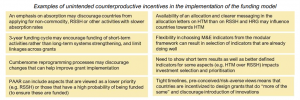
The SR2023 points out that the above are due to the implementers’ need to lower the risk of failure (in securing funding approval, or in demonstrating grant performance for instance) in the face of guidance, rules, realities or perceptions pertaining to the Global Fund’s funding model.
Moreover, Global Fund funding data does not allow for differentiated reporting on Human rights-and Gender Equality-related investments, particularly those that are mainstreamed in larger investments. However, funding data for specific, rights-related interventions for HIV and TB, indicates that there has been a steady increase in investments. Currently, the grant regulations of the Global Fund while including the five Human Rights standards also do not include a set of Gender Equality standards as per interview feedback from civil society. In contrast, the SR2023 points out that the Global Fund has introduced a mandatory Funding Request Annex, “Funding Priorities of Civil Society and Communities Most Affected by HIV, TB and Malaria”, even if these are not prioritized in the final Funding Request.
SR2023 interviewees raised questions about the inclusion of only four more countries for the Breaking Down Barriers initiative (as opposed to the earlier planned expansion to 35) in relation to Global Fund commitment to, and prioritisation of, HR and GE. One interviewee noted “The work around human rights over the strategy period was good, but more needs to be done. In this latest replenishment cycle, the Global Fund did not reach the envisaged USD18 billion, and so catalytic funding gets cut, which we have seen really supports human rights and gender equality outcomes. This makes you wonder where the Fund’s priorities lie.”
There are other Global Fund processes to support key populations such as creation of the Youth Council, so as to link adolescents and young people (AYP) living with or affected by HIV, TB and malaria with the organization; Her Voice Fund, is a private sector fund that works towards inclusivity of adolescents and strengthened the inclusion of adolescent girls and young women in Country Coordinating Mechanisms and Technical Working Groups (TWGs), among some of the decision-making platforms of the Global Fund. However, the SR2023 confirmed what has been a concern – that post-the funding request, participation declines. This needs the attention of the Board because there is an escalation in safety and security concerns as a result of the growing level of threat to members of KPs [key populations] participating in Global Fund structures. And this threat was also on the Country Coordinating Mechanisms as per an external RISE study quoted in the Global Fund report on it. You can read about it in Aidspan.
Country feedback noted that it is often, only the Global Fund that is supporting programming related to human rights and gender equality, which begs the question as the SR2023 points out, about what will happen to this work when the Global Fund’s support reduces at the time of its transitioning out since domestic investments on this score are insufficient?
Stakeholder Feedback
There is ongoing debate about where exactly Catalytic Investments (CIs), under which Strategic Initiatives for human rights and gender equality and some extent of RSSH come, should figure. While a stakeholder called for CIs in terms of new approaches or Technical Assistance to be integrated/mainstreamed within the grant operation, this was vehemently opposed by another because it would undermine the very flexibility and innovation that is the key to CIs. Although not part of the evaluation of Allocation Methodology, it did come up for discussion there as well. You can read about it here.
It was felt that RSSH required more focussed interventions in the context of regional priorities, with greater clarity on aligning objectives and better communication and partnerships for technical expertise, which also require expansion.
This issue of human rights and gender equality was also raised. One stakeholder felt that the recommendations for SR2023 did not go far enough by requesting gender equality related objectives alone. Instead, recommendations within RSSH, for instance, must include outcome level indicators that will assess the actual access of women to assets as well as examine the perceptions and beliefs that stigmatize and discriminate, the practise, the laws and institutions and policies. There was even a suggestion that, given the underfunding of community-led responses and human rights, Global Fund set-asides be used to support overcoming human rights barriers and address the increased sidelining of the space for civil society. There was also a demand to know the actual timeline for the two evaluations on the grant progress vis-à-vis human rights that had been proposed by the Secretariat at the 49th Board Meeting and a need to bolster community health strategies and address restrictive laws and policies.
While appreciating the progress in the eradication of HIV, TB and malaria, there are significant challenges to overcome. This will require that evidence-based strategies form an essential part of programmatic interventions. It was reiterated that human rights should remain central to the strategic goals of the organization. The need for a strategic focus on improving service delivery amidst anti-rights movements and other challenges was highlighted as a priority. The Global Fund’s Community, Rights and Gender approach requires scale up and an even more deliberate course of action.
Conclusion
The Global Fund needs to take a good, hard look at why the catalytic investments worked so well, what gaps were the matching funds filling, so that the next time there is a shortfall in replenishment, does the hit need to be taken by the catalytic funding given that it’s supporting human rights and gender equality? And there is also a need to understand that RSSH will be strengthened with gender equality and human rights as its foundational basis. It’s important because country feedback shows the continued relevance of the Global Fund (Figure 2).
Figure 2

Tags:
Leave a Comment
Comments
No comments yet. Be the first to comment!