Office of the Inspector General Annual Operational 2023 Report
N/A
Article Type:
REPORT
Author:
Date:
2024-04-27
ABSTRACT
The Office of the Inspector General submitted its report to the Global Fund Board for consideration at the 51st meeting of the Board meeting on April 22-24, 2024. The report provides a comprehensive picture of the OIG's work for 2023 and its work plans for 2024. This article summarizes the report and reactions from some stakeholders.
Introduction
The OIG's 2023 annual report emphasizes the Global Fund's commitment to its mission, with 59 million people benefiting from HIV, TB, and malaria services. However, financial constraints, political instability, and climate change continue to pose obstacles. Although progress has been made in fighting HIV and TB, malaria, prevention remains inadequate, and there are implementation gaps that need to be addressed.
Annual Opinion
The OIG's annual assessment of the Global Fund's governance, risk management, and internal controls provides independent assurance. They conduct risk-based audits and investigations, targeting areas identified through thorough risk assessments. Due to limited resources, not every aspect of the organization is audited, but priority is given to areas with significant risks. Audits are refined further to focus on significant residual risks. Investigations follow a triage process, prioritizing credible and material cases within the OIG's mandate. All activities of the OIG adhere to its charter and international professional standards.
Opinion
While no major issues threatened the Global Fund's objectives in 2023, strategic concerns required attention. Nevertheless, the OIG operated with autonomy and was provided with sufficient resources to fulfil its mandate in accordance with international standards.
Ongoing challenges
The OIG's work in 2023 highlighted six key challenges and areas for improvement within the Global Fund's programs:
1. Progress has been made in HIV and TB programs, with many countries meeting global targets. However, there are still challenges in reaching key populations and identifying new TB cases. The Global AIDS 2023 Report shows a record low in new HIV infections and reduced AIDS-related deaths since 2002. Similarly, the Global TB Report 2023 indicates high TB diagnosis and successful treatment rates. Nevertheless, barriers related to human rights and inadequate community interventions continue to hinder reaching key populations. Countries like Ghana, Malawi, and Cambodia are facing obstacles in TB case detection, private sector engagement, and diagnostic utilization. Therefore, there is a need for improved implementation strategies and resource allocation.
2. The fight against malaria has been disrupted by external threats and delays in program implementation, particularly in high-burden countries. The 2023 World Malaria Report highlights a global increase in cases, with audits revealing worsening outcomes in countries like Côte d'Ivoire, Uganda, Ethiopia, Burundi, and Namibia. Factors contributing to this rise include funding gaps, insecurity, climate change, and insecticide resistance. On a positive note, Ghana has successfully reduced malaria through effective prevention strategies. To address the malaria burden, it is essential to improve vector control interventions, distribute bed nets more effectively, and implement other interventions that have proven to be successful.
3. Although there have been significant investments in health system strengthening, challenges persist in implementation and monitoring. Prioritization of disease programs over Reliable and Sustainable Systems for Health (RSSH) activities has led to coordination issues and delays at both the country and Secretariat levels. Monitoring of RSSH activities is inadequate, worsening portfolio issues. While efforts have been made to improve RSSH implementation, there are fundamental challenges at the country level and in influencing institutions responsible for these activities.
4. The Global Fund's risk management has evolved, particularly during the COVID-19 pandemic. However, limited consideration of strategic external risks and slow implementation of mitigation actions limit its effectiveness. While processes have been strengthened, there is a need to formally consider key population challenges and TB detection issues at the initiative level. Although there have been improvements in operational risk management, inconsistencies in implementing mitigation actions continue to cause delays and risks. Formal engagement between stakeholders is crucial for achieving strategic objectives in a complex external environment.
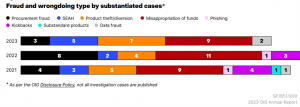
5. As the Secretariat continues to mature its management and response to evolving fraud risks, agility will be critical. Over the past decade, the Global Fund has focused on financial risk management and implemented measures to define fraud risk maturity levels and improve investigative capacity. While complaints to the OIG have increased, this doesn't necessarily indicate an increase in fraud risk as ongoing awareness campaigns may contribute to reporting. However, there is a growing trend of fraud at the sub-recipient level, surpassing that of the principal recipients. Weak oversight at the Principal Recipient level in some countries has led to systemic fraud risks. While measures are in place for known fraud schemes, emerging complex schemes require ongoing agility in response. Additionally, non-financial schemes such as product theft and diversion are emerging and require continuous monitoring. The Global Fund is expanding its focus beyond financial schemes and implementing fraud mitigation approaches. Moreover, substantiated cases of sexual exploitation and abuse have increased, prompting the Secretariat to intensify efforts to mitigate risks through awareness raising and capacity building.
 Country audits
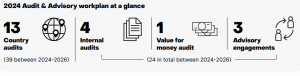
The OIG strategically plans internal audit and advisory engagements to improve organizational effectiveness and accountability. A risk-based approach is employed, aiming to conduct country audits of high-impact portfolios every three years and core portfolios every five years, as outlined in its Operational Progress Report for 2024-2026.
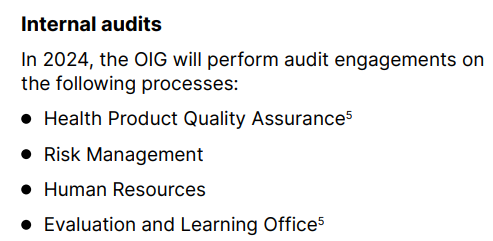
The Audit and Advisory Unit will focus on critical processes such as quality assurance for health products, risk management, and value for money reviews in its internal audits.
Country audits
The OIG strategically plans internal audit and advisory engagements to improve organizational effectiveness and accountability. A risk-based approach is employed, aiming to conduct country audits of high-impact portfolios every three years and core portfolios every five years, as outlined in its Operational Progress Report for 2024-2026.
The Audit and Advisory Unit will focus on critical processes such as quality assurance for health products, risk management, and value for money reviews in its internal audits.
 Advisory work will also continue, including ongoing efforts on the Additional Safeguards Policy and two additional reviews at the Secretariat's request. These efforts collectively aim to reinforce the Global Fund's operations and foster accountability.
Professional Services Unit (PSU)
In 2023, the Professional Services Unit (PSU) played a crucial role in managing case intake, improving analytical capabilities, and providing operational support within the OIG. This facilitated efficient processing of cases, enhanced decision-making, and ensured smooth workflow and coordination within the organization, benefiting both the Audit and Advisory and Investigations teams.
Case intake process
Despite the rise in complaints, the number of investigations opened did not increase proportionately due to strategic resource allocation. The Case Intake Team completed 387 screening reports, making adjustments to the assessment process to improve timeliness. Complaints are carefully considered for potential referrals or analysis, even if they don't lead to formal investigations. Technological innovations, including speech-to-text solutions and artificial intelligence tools, have been integrated to streamline data analysis and improve efficiency. The Operational Support Unit played a crucial role in facilitating the delivery of the OIG's work plans in 2023, with a focus on quality assurance and knowledge management. Looking ahead to 2024, the unit will continue to advance the implementation of the advanced analytic roadmap and ensure compliance with global auditing standards through comprehensive reviews.
Investigations
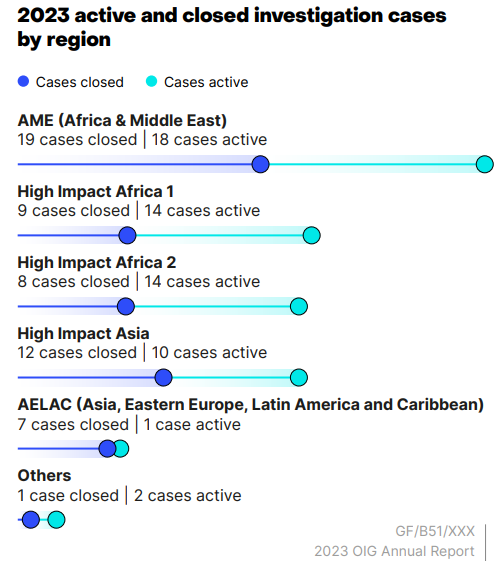
The Investigations Unit of the OIG experienced significant changes in 2023, including the appointment of a new Head of Investigations. The easing of COVID-19 restrictions allowed investigative teams to resume work on cases put on hold during the pandemic. By the end of 2023, the OIG closed 56 investigations out of 115 active cases (data by region below), resulting in a 49% closure rate, slightly higher than the previous year.
Advisory work will also continue, including ongoing efforts on the Additional Safeguards Policy and two additional reviews at the Secretariat's request. These efforts collectively aim to reinforce the Global Fund's operations and foster accountability.
Professional Services Unit (PSU)
In 2023, the Professional Services Unit (PSU) played a crucial role in managing case intake, improving analytical capabilities, and providing operational support within the OIG. This facilitated efficient processing of cases, enhanced decision-making, and ensured smooth workflow and coordination within the organization, benefiting both the Audit and Advisory and Investigations teams.
Case intake process
Despite the rise in complaints, the number of investigations opened did not increase proportionately due to strategic resource allocation. The Case Intake Team completed 387 screening reports, making adjustments to the assessment process to improve timeliness. Complaints are carefully considered for potential referrals or analysis, even if they don't lead to formal investigations. Technological innovations, including speech-to-text solutions and artificial intelligence tools, have been integrated to streamline data analysis and improve efficiency. The Operational Support Unit played a crucial role in facilitating the delivery of the OIG's work plans in 2023, with a focus on quality assurance and knowledge management. Looking ahead to 2024, the unit will continue to advance the implementation of the advanced analytic roadmap and ensure compliance with global auditing standards through comprehensive reviews.
Investigations
The Investigations Unit of the OIG experienced significant changes in 2023, including the appointment of a new Head of Investigations. The easing of COVID-19 restrictions allowed investigative teams to resume work on cases put on hold during the pandemic. By the end of 2023, the OIG closed 56 investigations out of 115 active cases (data by region below), resulting in a 49% closure rate, slightly higher than the previous year.
 Implementer-led investigations played a significant role, accounting for more than half of the completed investigations. Prevention outreach efforts led to a nearly 95% increase in complaints since 2020, with the OIG conducting 17 training and outreach sessions with stakeholders in 2023.
In 2024, the OIG plans to complete approximately 50 investigations, focusing on long-standing cases and strategically identifying systemic integrity risks. Proactive integrity reviews and enhanced fraud prevention efforts are also on the agenda for the coming year.
Outreach and stakeholder engagement
Outreach and stakeholder engagement are crucial elements of the OIG's strategy, supporting its mandate and ensuring effective oversight in the development sector and implementing countries. The OIG has increased cooperation with Supreme Audit Institutions (SAIs) to enhance public financial management systems globally. Collaborative efforts include participating in conferences, such as the SAI-Donor Indaba in South Africa and the INTOSAI Conference in Jamaica, to promote capacity building and cooperation. Additionally, the OIG has engaged in anti-corruption activities, contributing to events like Transparency International's discussion on corruption in the health sector and providing fraud identification training at the SAIGA conference in Johannesburg.
Partnering with industry regulators
In 2023, the OIG collaborated with oversight bodies of peer organizations like the World Bank, IMF, USAID, and various UN agencies to exchange best practices and insights. Engagements included conferences like the 23rd Conference of International Investigators and UNRIAS and RIAS conferences, facilitating discussions on emerging integrity issues and sharing best practices. In 2024, the OIG will co-host the Global Health Campus event with GAVI and WHO to bolster partnerships. Additionally, plans are in place to host investigative units from major recipients to enhance best practice sharing and improve reporting mechanisms for wrongdoing.
Performance against 2023 key performance indicators
Core assurance delivery
In response to complaints, the Office of the Inspector General met its goal of triaging and completing evaluations within the required timeframe, averaging 42.5 days for all cases and 50.7 days for high-priority complaints. However, for investigations, the OIG fell short of the average time to issue investigative case closure memos, taking 13.3 months for OIG-led cases and 16.8 months for implementer-led cases. Similarly, while the goal of publishing at least five investigative reports was met, the average time to prepare draft investigative reports for publication was 23.3 months, impacted by challenges during the pandemic. In anti-fraud activities, the OIG exceeded its target, completing 113% of planned activities and reaching 900 individuals in various Global Fund portfolios. For audits and advisory reports, the OIG met its targets, issuing 14 of 16 planned draft audits and completing two advisory reports from the 2023 work plan.
Risk and impact
As of December 2023, the Office of the Inspector General has made progress in several performance areas. While it partially met its audit coverage goals for HIV, TB, and malaria, pandemic-related travel restrictions impacted country audits in 2021, with recovery expected in 2024. The OIG fully covered high-risk areas identified in the Organizational Risk Register over a three-year cycle. Satisfaction with stakeholder engagement was generally high, with positive feedback from audit engagement surveys, board and audit and finance committee surveys, and post-event anti-fraud awareness surveys.
However, implementation of Agreed Management Actions (AMAs) fell short, with only 26% implemented by the due date. overdue AMAs have increased since the last reporting period with implementation yet to commence for 20% of those AMAs. Among overdue and long-overdue AMAs, those requiring cross-departmental coordination had an average delay of a year after the due date as compared to country-specific AMAs, which had an average delay of five months after the due date.
Implementer-led investigations played a significant role, accounting for more than half of the completed investigations. Prevention outreach efforts led to a nearly 95% increase in complaints since 2020, with the OIG conducting 17 training and outreach sessions with stakeholders in 2023.
In 2024, the OIG plans to complete approximately 50 investigations, focusing on long-standing cases and strategically identifying systemic integrity risks. Proactive integrity reviews and enhanced fraud prevention efforts are also on the agenda for the coming year.
Outreach and stakeholder engagement
Outreach and stakeholder engagement are crucial elements of the OIG's strategy, supporting its mandate and ensuring effective oversight in the development sector and implementing countries. The OIG has increased cooperation with Supreme Audit Institutions (SAIs) to enhance public financial management systems globally. Collaborative efforts include participating in conferences, such as the SAI-Donor Indaba in South Africa and the INTOSAI Conference in Jamaica, to promote capacity building and cooperation. Additionally, the OIG has engaged in anti-corruption activities, contributing to events like Transparency International's discussion on corruption in the health sector and providing fraud identification training at the SAIGA conference in Johannesburg.
Partnering with industry regulators
In 2023, the OIG collaborated with oversight bodies of peer organizations like the World Bank, IMF, USAID, and various UN agencies to exchange best practices and insights. Engagements included conferences like the 23rd Conference of International Investigators and UNRIAS and RIAS conferences, facilitating discussions on emerging integrity issues and sharing best practices. In 2024, the OIG will co-host the Global Health Campus event with GAVI and WHO to bolster partnerships. Additionally, plans are in place to host investigative units from major recipients to enhance best practice sharing and improve reporting mechanisms for wrongdoing.
Performance against 2023 key performance indicators
Core assurance delivery
In response to complaints, the Office of the Inspector General met its goal of triaging and completing evaluations within the required timeframe, averaging 42.5 days for all cases and 50.7 days for high-priority complaints. However, for investigations, the OIG fell short of the average time to issue investigative case closure memos, taking 13.3 months for OIG-led cases and 16.8 months for implementer-led cases. Similarly, while the goal of publishing at least five investigative reports was met, the average time to prepare draft investigative reports for publication was 23.3 months, impacted by challenges during the pandemic. In anti-fraud activities, the OIG exceeded its target, completing 113% of planned activities and reaching 900 individuals in various Global Fund portfolios. For audits and advisory reports, the OIG met its targets, issuing 14 of 16 planned draft audits and completing two advisory reports from the 2023 work plan.
Risk and impact
As of December 2023, the Office of the Inspector General has made progress in several performance areas. While it partially met its audit coverage goals for HIV, TB, and malaria, pandemic-related travel restrictions impacted country audits in 2021, with recovery expected in 2024. The OIG fully covered high-risk areas identified in the Organizational Risk Register over a three-year cycle. Satisfaction with stakeholder engagement was generally high, with positive feedback from audit engagement surveys, board and audit and finance committee surveys, and post-event anti-fraud awareness surveys.
However, implementation of Agreed Management Actions (AMAs) fell short, with only 26% implemented by the due date. overdue AMAs have increased since the last reporting period with implementation yet to commence for 20% of those AMAs. Among overdue and long-overdue AMAs, those requiring cross-departmental coordination had an average delay of a year after the due date as compared to country-specific AMAs, which had an average delay of five months after the due date.
 Operations and quality
As of December 31, 2023, the Office of the Inspector General has made significant progress in achieving key performance goals. Actual expenditures were 1% below the approved 2023 budget, demonstrating effective cost management. The OIG issued an annual statement of assurance on the Global Fund's governance, risk management, and controls, underscoring its commitment to transparency and accountability. In addition, annual internal quality self-assessments confirmed compliance with the requirements of the International Standards for the Professional Practice of Internal Auditing (IIA) and the Chartered Institute of Internal Auditors (CII). While the triennial external quality assurance review was not due until 2024, the OIG remains committed to maintaining the highest standards of quality and compliance.
Quality assurance
The OIG ensures the quality of its work through annual self-assessments and external assessments every three years, exceeding standard requirements. In 2023, it addressed five of six areas for improvement from the previous year's assessment, with plans to enhance staff training by mid-2024. The 2023 self-assessment confirmed compliance with professional standards, although minor improvements are planned, particularly in the timeliness of audits and investigations. An external assessment is planned for 2024, with independent assessors appointed by the Audit and Finance Committee.
Stakeholder Feedback undertaken by the OIG
Stakeholder feedback continues to be a valuable contribution to the OIG's performance. It provides important insights into areas that are working well and those where the OIG can improve.
Feedback from the Board and Committees
The OIG received overwhelmingly positive feedback from the Global Fund Board and Audit and Finance Committee members in a recent performance survey.
Operations and quality
As of December 31, 2023, the Office of the Inspector General has made significant progress in achieving key performance goals. Actual expenditures were 1% below the approved 2023 budget, demonstrating effective cost management. The OIG issued an annual statement of assurance on the Global Fund's governance, risk management, and controls, underscoring its commitment to transparency and accountability. In addition, annual internal quality self-assessments confirmed compliance with the requirements of the International Standards for the Professional Practice of Internal Auditing (IIA) and the Chartered Institute of Internal Auditors (CII). While the triennial external quality assurance review was not due until 2024, the OIG remains committed to maintaining the highest standards of quality and compliance.
Quality assurance
The OIG ensures the quality of its work through annual self-assessments and external assessments every three years, exceeding standard requirements. In 2023, it addressed five of six areas for improvement from the previous year's assessment, with plans to enhance staff training by mid-2024. The 2023 self-assessment confirmed compliance with professional standards, although minor improvements are planned, particularly in the timeliness of audits and investigations. An external assessment is planned for 2024, with independent assessors appointed by the Audit and Finance Committee.
Stakeholder Feedback undertaken by the OIG
Stakeholder feedback continues to be a valuable contribution to the OIG's performance. It provides important insights into areas that are working well and those where the OIG can improve.
Feedback from the Board and Committees
The OIG received overwhelmingly positive feedback from the Global Fund Board and Audit and Finance Committee members in a recent performance survey.
 The survey suggests that the OIG’s responsiveness to the Board's expectations and priorities is an area for potential improvement. Overall, the responses underscore the critical role of the OIG in ensuring the integrity and effectiveness of the Global Fund's operations.
Audit engagement feedback
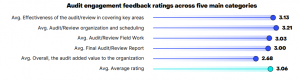
Audit engagement feedback from auditees has shown a steady increase in responses over the past four years, indicating growing engagement with the audit process. Overall, the feedback suggests a strong appreciation of the contribution of audits, with potential areas for improvement in terms of thoroughness and detailed reporting.
The survey suggests that the OIG’s responsiveness to the Board's expectations and priorities is an area for potential improvement. Overall, the responses underscore the critical role of the OIG in ensuring the integrity and effectiveness of the Global Fund's operations.
Audit engagement feedback
Audit engagement feedback from auditees has shown a steady increase in responses over the past four years, indicating growing engagement with the audit process. Overall, the feedback suggests a strong appreciation of the contribution of audits, with potential areas for improvement in terms of thoroughness and detailed reporting.
 Stakeholder Feedback at the 51st Global Fund Board Meeting
The session on the OIG report began by discussing the "I Speak Out" campaign and its role in promoting transparency and accountability within the Global Fund.
Stakeholder Feedback at the 51st Global Fund Board Meeting
The session on the OIG report began by discussing the "I Speak Out" campaign and its role in promoting transparency and accountability within the Global Fund.
 Concerns were expressed about financial misconduct and the effectiveness of oversight mechanisms, with a call for improved financial governance to combat corruption. Attention was also given to fund recovery and financial management, emphasizing the need for transparency and accountability.
Stakeholders, however, urged prioritizing protection from sexual exploitation, abuse, and harassment (PSEAH), emphasizing the importance of independence for related mechanisms and collaboration with partner organizations. A demand was also made for a clear prioritization framework to address the issue of poor implementation of AMAs without compromising other tasks.
Significant progress in stakeholder engagement and operational efficiency over the past decade was recognized as crucial to the Organization's effectiveness in addressing global health challenges. Simplification was advocated to facilitate stakeholder engagement and resource mobilization. The importance of domestic resource mobilization and robust funding strategies in sustaining efforts against targeted diseases, considering external factors such as the impact of the COVID-19 pandemic on funding commitments was highlighted. Concerns were raised about the organization's capacity to effectively monitor human rights violations, suggesting the need for reinforced resources and strategies in this regard. However, there was a collective recognition of the importance of continually improving governance and operational efficiency to effectively accomplish the organization's goals.
Recommendations:
Several strategic recommendations were made. These include the following:
- Enhance Governance Frameworks: Implement more robust governance frameworks to improve accountability and transparency, particularly in financial and operational processes.
- Bolster Human Rights Monitoring Capabilities: Allocate more resources towards developing effective human rights monitoring capabilities to ensure interventions are respectful and appropriate within local contexts.
- Streamline Processes for Efficiency: Continue efforts to streamline processes and reduce bureaucratic hurdles to improve program delivery and operational efficiency.
- Deepen Stakeholder Engagement: Further deepen stakeholder engagement to enhance resource mobilization efforts and ensure the sustainability of funding.
Conclusion
While facing various challenges and adapting its approaches, the OIG continues to serve as a fundamental pillar of assurance and integrity within the organization with its unwavering commitment to maintaining accountability, transparency and effectiveness.
Concerns were expressed about financial misconduct and the effectiveness of oversight mechanisms, with a call for improved financial governance to combat corruption. Attention was also given to fund recovery and financial management, emphasizing the need for transparency and accountability.
Stakeholders, however, urged prioritizing protection from sexual exploitation, abuse, and harassment (PSEAH), emphasizing the importance of independence for related mechanisms and collaboration with partner organizations. A demand was also made for a clear prioritization framework to address the issue of poor implementation of AMAs without compromising other tasks.
Significant progress in stakeholder engagement and operational efficiency over the past decade was recognized as crucial to the Organization's effectiveness in addressing global health challenges. Simplification was advocated to facilitate stakeholder engagement and resource mobilization. The importance of domestic resource mobilization and robust funding strategies in sustaining efforts against targeted diseases, considering external factors such as the impact of the COVID-19 pandemic on funding commitments was highlighted. Concerns were raised about the organization's capacity to effectively monitor human rights violations, suggesting the need for reinforced resources and strategies in this regard. However, there was a collective recognition of the importance of continually improving governance and operational efficiency to effectively accomplish the organization's goals.
Recommendations:
Several strategic recommendations were made. These include the following:
- Enhance Governance Frameworks: Implement more robust governance frameworks to improve accountability and transparency, particularly in financial and operational processes.
- Bolster Human Rights Monitoring Capabilities: Allocate more resources towards developing effective human rights monitoring capabilities to ensure interventions are respectful and appropriate within local contexts.
- Streamline Processes for Efficiency: Continue efforts to streamline processes and reduce bureaucratic hurdles to improve program delivery and operational efficiency.
- Deepen Stakeholder Engagement: Further deepen stakeholder engagement to enhance resource mobilization efforts and ensure the sustainability of funding.
Conclusion
While facing various challenges and adapting its approaches, the OIG continues to serve as a fundamental pillar of assurance and integrity within the organization with its unwavering commitment to maintaining accountability, transparency and effectiveness.
- Looking ahead, the Global Fund faces challenges such as financial limitations, security issues, and climate change concerns as it pursues its ambitious strategy. Despite these constraints, efforts are underway to streamline processes and support countries with varying operational contexts. Initiatives aim to reduce reporting requirements and enhance staff deployment efficiency. Ensuring the sustainability of the supply chain is crucial, which requires balancing national and parallel systems. Mobilizing domestic health financing is also crucial, but economic constraints hinder progress and cause program disruptions in some countries. To address resource limitations, prioritizing value for money and fostering effective collaboration with other organizations is essential for the Global Partnership.
Country audits
The OIG strategically plans internal audit and advisory engagements to improve organizational effectiveness and accountability. A risk-based approach is employed, aiming to conduct country audits of high-impact portfolios every three years and core portfolios every five years, as outlined in its Operational Progress Report for 2024-2026.
The Audit and Advisory Unit will focus on critical processes such as quality assurance for health products, risk management, and value for money reviews in its internal audits.
Advisory work will also continue, including ongoing efforts on the Additional Safeguards Policy and two additional reviews at the Secretariat's request. These efforts collectively aim to reinforce the Global Fund's operations and foster accountability.
Professional Services Unit (PSU)
In 2023, the Professional Services Unit (PSU) played a crucial role in managing case intake, improving analytical capabilities, and providing operational support within the OIG. This facilitated efficient processing of cases, enhanced decision-making, and ensured smooth workflow and coordination within the organization, benefiting both the Audit and Advisory and Investigations teams.
Case intake process
Despite the rise in complaints, the number of investigations opened did not increase proportionately due to strategic resource allocation. The Case Intake Team completed 387 screening reports, making adjustments to the assessment process to improve timeliness. Complaints are carefully considered for potential referrals or analysis, even if they don't lead to formal investigations. Technological innovations, including speech-to-text solutions and artificial intelligence tools, have been integrated to streamline data analysis and improve efficiency. The Operational Support Unit played a crucial role in facilitating the delivery of the OIG's work plans in 2023, with a focus on quality assurance and knowledge management. Looking ahead to 2024, the unit will continue to advance the implementation of the advanced analytic roadmap and ensure compliance with global auditing standards through comprehensive reviews.
Investigations
The Investigations Unit of the OIG experienced significant changes in 2023, including the appointment of a new Head of Investigations. The easing of COVID-19 restrictions allowed investigative teams to resume work on cases put on hold during the pandemic. By the end of 2023, the OIG closed 56 investigations out of 115 active cases (data by region below), resulting in a 49% closure rate, slightly higher than the previous year.
Implementer-led investigations played a significant role, accounting for more than half of the completed investigations. Prevention outreach efforts led to a nearly 95% increase in complaints since 2020, with the OIG conducting 17 training and outreach sessions with stakeholders in 2023.
In 2024, the OIG plans to complete approximately 50 investigations, focusing on long-standing cases and strategically identifying systemic integrity risks. Proactive integrity reviews and enhanced fraud prevention efforts are also on the agenda for the coming year.
Outreach and stakeholder engagement
Outreach and stakeholder engagement are crucial elements of the OIG's strategy, supporting its mandate and ensuring effective oversight in the development sector and implementing countries. The OIG has increased cooperation with Supreme Audit Institutions (SAIs) to enhance public financial management systems globally. Collaborative efforts include participating in conferences, such as the SAI-Donor Indaba in South Africa and the INTOSAI Conference in Jamaica, to promote capacity building and cooperation. Additionally, the OIG has engaged in anti-corruption activities, contributing to events like Transparency International's discussion on corruption in the health sector and providing fraud identification training at the SAIGA conference in Johannesburg.
Partnering with industry regulators
In 2023, the OIG collaborated with oversight bodies of peer organizations like the World Bank, IMF, USAID, and various UN agencies to exchange best practices and insights. Engagements included conferences like the 23rd Conference of International Investigators and UNRIAS and RIAS conferences, facilitating discussions on emerging integrity issues and sharing best practices. In 2024, the OIG will co-host the Global Health Campus event with GAVI and WHO to bolster partnerships. Additionally, plans are in place to host investigative units from major recipients to enhance best practice sharing and improve reporting mechanisms for wrongdoing.
Performance against 2023 key performance indicators
Core assurance delivery
In response to complaints, the Office of the Inspector General met its goal of triaging and completing evaluations within the required timeframe, averaging 42.5 days for all cases and 50.7 days for high-priority complaints. However, for investigations, the OIG fell short of the average time to issue investigative case closure memos, taking 13.3 months for OIG-led cases and 16.8 months for implementer-led cases. Similarly, while the goal of publishing at least five investigative reports was met, the average time to prepare draft investigative reports for publication was 23.3 months, impacted by challenges during the pandemic. In anti-fraud activities, the OIG exceeded its target, completing 113% of planned activities and reaching 900 individuals in various Global Fund portfolios. For audits and advisory reports, the OIG met its targets, issuing 14 of 16 planned draft audits and completing two advisory reports from the 2023 work plan.
Risk and impact
As of December 2023, the Office of the Inspector General has made progress in several performance areas. While it partially met its audit coverage goals for HIV, TB, and malaria, pandemic-related travel restrictions impacted country audits in 2021, with recovery expected in 2024. The OIG fully covered high-risk areas identified in the Organizational Risk Register over a three-year cycle. Satisfaction with stakeholder engagement was generally high, with positive feedback from audit engagement surveys, board and audit and finance committee surveys, and post-event anti-fraud awareness surveys.
However, implementation of Agreed Management Actions (AMAs) fell short, with only 26% implemented by the due date. overdue AMAs have increased since the last reporting period with implementation yet to commence for 20% of those AMAs. Among overdue and long-overdue AMAs, those requiring cross-departmental coordination had an average delay of a year after the due date as compared to country-specific AMAs, which had an average delay of five months after the due date.
Operations and quality
As of December 31, 2023, the Office of the Inspector General has made significant progress in achieving key performance goals. Actual expenditures were 1% below the approved 2023 budget, demonstrating effective cost management. The OIG issued an annual statement of assurance on the Global Fund's governance, risk management, and controls, underscoring its commitment to transparency and accountability. In addition, annual internal quality self-assessments confirmed compliance with the requirements of the International Standards for the Professional Practice of Internal Auditing (IIA) and the Chartered Institute of Internal Auditors (CII). While the triennial external quality assurance review was not due until 2024, the OIG remains committed to maintaining the highest standards of quality and compliance.
Quality assurance
The OIG ensures the quality of its work through annual self-assessments and external assessments every three years, exceeding standard requirements. In 2023, it addressed five of six areas for improvement from the previous year's assessment, with plans to enhance staff training by mid-2024. The 2023 self-assessment confirmed compliance with professional standards, although minor improvements are planned, particularly in the timeliness of audits and investigations. An external assessment is planned for 2024, with independent assessors appointed by the Audit and Finance Committee.
Stakeholder Feedback undertaken by the OIG
Stakeholder feedback continues to be a valuable contribution to the OIG's performance. It provides important insights into areas that are working well and those where the OIG can improve.
Feedback from the Board and Committees
The OIG received overwhelmingly positive feedback from the Global Fund Board and Audit and Finance Committee members in a recent performance survey.
The survey suggests that the OIG’s responsiveness to the Board's expectations and priorities is an area for potential improvement. Overall, the responses underscore the critical role of the OIG in ensuring the integrity and effectiveness of the Global Fund's operations.
Audit engagement feedback
Audit engagement feedback from auditees has shown a steady increase in responses over the past four years, indicating growing engagement with the audit process. Overall, the feedback suggests a strong appreciation of the contribution of audits, with potential areas for improvement in terms of thoroughness and detailed reporting.
Stakeholder Feedback at the 51st Global Fund Board Meeting
The session on the OIG report began by discussing the "I Speak Out" campaign and its role in promoting transparency and accountability within the Global Fund.
Concerns were expressed about financial misconduct and the effectiveness of oversight mechanisms, with a call for improved financial governance to combat corruption. Attention was also given to fund recovery and financial management, emphasizing the need for transparency and accountability.
Stakeholders, however, urged prioritizing protection from sexual exploitation, abuse, and harassment (PSEAH), emphasizing the importance of independence for related mechanisms and collaboration with partner organizations. A demand was also made for a clear prioritization framework to address the issue of poor implementation of AMAs without compromising other tasks.
Significant progress in stakeholder engagement and operational efficiency over the past decade was recognized as crucial to the Organization's effectiveness in addressing global health challenges. Simplification was advocated to facilitate stakeholder engagement and resource mobilization. The importance of domestic resource mobilization and robust funding strategies in sustaining efforts against targeted diseases, considering external factors such as the impact of the COVID-19 pandemic on funding commitments was highlighted. Concerns were raised about the organization's capacity to effectively monitor human rights violations, suggesting the need for reinforced resources and strategies in this regard. However, there was a collective recognition of the importance of continually improving governance and operational efficiency to effectively accomplish the organization's goals.
Recommendations:
Several strategic recommendations were made. These include the following:
- Enhance Governance Frameworks: Implement more robust governance frameworks to improve accountability and transparency, particularly in financial and operational processes.
- Bolster Human Rights Monitoring Capabilities: Allocate more resources towards developing effective human rights monitoring capabilities to ensure interventions are respectful and appropriate within local contexts.
- Streamline Processes for Efficiency: Continue efforts to streamline processes and reduce bureaucratic hurdles to improve program delivery and operational efficiency.
- Deepen Stakeholder Engagement: Further deepen stakeholder engagement to enhance resource mobilization efforts and ensure the sustainability of funding.
Conclusion
While facing various challenges and adapting its approaches, the OIG continues to serve as a fundamental pillar of assurance and integrity within the organization with its unwavering commitment to maintaining accountability, transparency and effectiveness.
Publication Date:
2024-04-27
Tags:
Leave a Comment
Comments
No comments yet. Be the first to comment!