Georgia's Country Coordinating Mechanism: A Model of Effective Governance in Public Health
N/A
ABSTRACT
In this article, we highlight Georgia's Country Coordinating Mechanism as a remarkable success story in public health governance. One of its standout achievements is its integration into national structures, enabling it to lead coordination efforts of HIV, tuberculosis, and malaria even as the Global Fund phases out of the country. This success can be attributed to strong leadership and governmental support. Its model of governance and collaborative action serves as a beacon for other countries seeking to strengthen their health systems.
Georgia's Country Coordinating Mechanism (CCM) stands out as a beacon of success due to its effective public health governance. Through successful integration into national structures, the Georgia-CCM now spearheads the coordination of HIV, tuberculosis (TB), and malaria responses, ensuring continuity even as the Global Fund transitions out of the country. Empowered by competent leadership and governmental support, Georgia's CCM has demonstrated remarkable effectiveness in coordinating health initiatives since its establishment in 2003. Georgia's CCM collaborates with various stakeholders and the Global Fund, contributing significantly to the success of disease control efforts. It serves as a model for effective governance and collaborative action in public health, offering valuable insights for strengthening health systems globally.
CCMs are the cornerstone of Global Fund’s partnership model
The success of global health initiatives often depends on countries taking charge and working together. Leading this effort in the Global Fund framework are CCMs. CCMs act like national committees, handling funding requests, deciding who receives funds, and ensuring projects run smoothly. They bring together people from all sectors involved in fighting diseases like HIV, tuberculosis, and malaria: government, NGOs, community groups, affected individuals, universities, partners, faith-based organizations, businesses, and experts. Similarly, Regional Coordinating Mechanisms (RCMs) manage grants at a regional level. These inclusive bodies are crucial for effective collaboration, ensuring decisions are made collectively and projects are carried out effectively.
There are 110 CCMs/RCMs overseeing more than 300 grants in 130 countries, with over 4,500 members who volunteer their time. When CCMs function well, they keep projects on track and ensure health programs continue, playing a vital role in combating HIV, tuberculosis, and malaria. Their significance is emphasized in the Global Fund Strategy 2023-2028, which aims to enhance decision-making, oversight, and evaluation by involving community members more. The strategy also seeks to integrate CCMs better into national health structures, ensuring everyone has a say in decision-making and monitoring how funds are used.
The Evolution of Country Coordinating Mechanisms
Since 2018, the Global Fund has been on a transformative journey with its CCM Evolution project. We have previously covered CCM evolution in our GFO newsletter, including the Global Fund Board's approval of the CCM evolution initiative, the Office of the Inspector General's audit report on the Country Coordinating Mechanism, and the Global Fund Board discussions on the role and evolution of CCMs. Recognizing the pivotal role CCMs play in the fight against AIDS, TB, and malaria, the initiative aims to revamp and fortify the operational dynamics of these mechanisms, thereby maximizing their impact on the ground.
CCMs, designed to oversee Global Fund programs at the national level, often fall short of expectations. Despite their potential for transformative change, they frequently struggle to effectively engage communities and civil society, resulting in suboptimal program performance. This realization spurred the inception of the CCM Evolution project, a concerted effort to reengineer the way CCMs operate.
The project focuses on four main areas: oversight, engagement, positioning, and operations. Oversight means making sure Global Fund programs run smoothly by finding and fixing problems through careful monitoring. Engagement is about involving key groups in decision-making, like communities and civil society, to keep things transparent and accountable. Positioning aims to integrate CCMs into national systems so that health programs can continue even without direct Global Fund support. Operations focus on making sure CCMs have strong leadership and follow the rules properly.
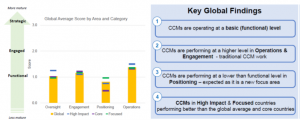
A Board Document reveals notable progress in the maturity levels of CCMs across four key areas. This assessment indicates that CCMs have achieved the highest level of maturity in operations, followed closely by engagement and oversight (Figure 1). However, the analysis also underscores a significant gap in the positioning of CCMs, signaling a need for additional support and intervention in this particular domain.
Figure 1: CCM Evolution results
Source: A Global Fund Board document
The robust maturity observed in operations suggests that CCMs have made substantial strides in strengthening their governance responsibilities, ensuring adherence to protocols, and enhancing leadership capacities within their structures. This accomplishment highlights the efficacy of efforts aimed at bolstering operational efficiency and effectiveness within CCMs, ultimately contributing to smoother implementation of Global Fund programs and improved grant management practices.
Similarly, the notable progress in engagement signifies a growing recognition of the importance of community involvement and stakeholder engagement in decision-making processes. By actively involving key populations and civil society organizations, CCMs have fostered greater transparency, accountability, and inclusivity in their operations, thereby enhancing the overall responsiveness and relevance of Global Fund initiatives to the needs of affected communities.
However, despite advancements in operations and engagement, the analysis identifies a significant shortfall in the positioning of CCMs. This indicates a lack of integration of CCMs into national health governance structures, potentially hindering their long-term sustainability and effectiveness beyond the scope of Global Fund support. The identified gap underscores the necessity for targeted interventions aimed at aligning CCMs more closely with existing national health frameworks, thereby ensuring seamless coordination and continuity of health programs beyond the tenure of specific grants.
In light of these findings, it is imperative for stakeholders to prioritize efforts aimed at addressing the identified gaps in CCM positioning. By providing targeted support and resources to enhance the integration of CCMs within national health systems, stakeholders can bolster the long-term sustainability and impact of Global Fund initiatives, ultimately advancing the collective goal of combating HIV, tuberculosis, and malaria on a global scale.
Georgia's Country Coordinating Mechanism: A Model of Effective Governance in Public Health
Georgia's CCM serves as a model of effective public health governance. Established in 2003 to oversee Global Fund programs targeting HIV, TB, and malaria, the CCM has evolved into a robust entity driving coordinated efforts in combating these diseases.
Historically, CCMs across the globe have grappled with integration into national systems, often functioning as parallel entities. However, Georgia's approach has been distinct. Recognizing the importance of local ownership and stakeholder collaboration, the Georgian government passed a resolution in 2012, designating the CCM as the national authority for addressing public health challenges posed by HIV, TB and malaria. This pivotal move empowered the CCM to collaborate with various organizations, host conferences and workshops, and mobilize resources for disease control efforts. Additionally, within its cooperation with the Global Fund, the CCM plays a crucial role in reviewing project proposals, defining reporting requirements, and determining assessment schedules for programs and projects. By integrating the CCM into national structures, Georgia has enhanced its ability to coordinate and sustain responses to these diseases, both domestically and through international partnerships.
A World Health Organization (WHO) document attributes the success of Georgia's CCM to several crucial factors. Key among these is the presence of competent senior leadership, distinguished by robust management capabilities and acknowledgment from governmental authorities. Furthermore, the active involvement of the Minister of Health in shaping CCM policies and meeting its requirements has bolstered its credibility and operational efficacy.
Collaboration lies at the heart of Georgia's CCM. A highly participatory and collaborative environment, coupled with an efficient secretariat, ensures smooth functioning and continuity. The secretariat's low turnover rate fosters institutional memory, while its role as the focal point for CCM leadership and membership ensures alignment with Global Fund procedures and standards.
Throughout the CCM Evolution, key populations, including people who inject drugs, were deeply engaged, participating in all project stages, disseminating information to their communities, and suggesting solutions. For example, according to a document of the International Network of People who Use Drugs, people who inject drugs have been actively involved in Georgia's CCM, representing key populations in the Policy and Advocacy Advisory Council. They play a significant role in developing HIV and TB Funding Requests, Transition and Sustainability Plan, and CCM Transition Plan. Having key populations involved has led to better cooperation and coordination within the CCM, with the voices of key populations being heard and respected more. For instance, people who inject drugs successfully advocated for the resumption of take-home methadone doses using the CCM platform.
Moreover, the Policy Advisory and Advocacy Council (PAAC) has emerged as a cornerstone of support for Georgia's CCM. Established by the CCM in March 2016, PAAC assists in identifying challenges during the transition from Global Fund to state funding for TB and HIV programs and offers potential solutions. Comprising key populations, people living with HIV and TB, and government and non-governmental organizations, the PAAC provides critical technical assistance and guidance. It engages in advocacy efforts to improve legislation, regulations, and operational policies related to TB and HIV prevention and service delivery. PAAC's primary role is to steer the development of a sustainability plan, ensuring universal access to quality HIV testing, prevention, care, and support, along with TB diagnostic and treatment services using domestic resources. Its involvement in transition planning and strategic plan advisement underscores its significance in shaping Georgia's public health landscape.
Trust and networking among CCM members further enhance its effectiveness. Frequent interactions within the health sector foster a spirit of trust and consensus-building, facilitating open discussions on program design and implementation. This collaborative ethos ensures that the CCM remains responsive to the evolving needs of the population it serves.
According to the WHO document, evaluations have underscored the efficacy of Georgia's CCM, scoring highly across key responsibility domains such as oversight (92%), engagement (75%), positioning (92%) and operations (92%). These findings validate Georgia's model of governance in public health and serve as a testament to the transformative potential of coordinated efforts.
As the global health community seeks sustainable solutions to pressing challenges, Georgia's CCM stands as a shining example of effective governance and collaborative action. Its success story offers valuable insights for countries striving to strengthen their health systems and maximize the impact of their public health initiatives.
Tags:
Leave a Comment
Comments
No comments yet. Be the first to comment!