Global Fund Grants to the Republic of Burundi
N/A
ABSTRACT
The Office of the Inspector General’s audit report on the Global Fund grants to Burundi yields some good news on the progress fighting HIV/AIDS, TB and malaria despite the effects of the COVID-19 pandemic. Even though the country is classified as a Challenging Operating Environment, the audit opinions are not adverse. Unaccounted distribution of some long lasting insecticidal nets is reported; and this is an issue that has arisen in several countries. The one surprise and concern is the OIG finding regarding some shortcomings in UNDP’s performance as the major Principal Recipient, which the Global Fund Secretariat can only request UNDP to address.
Background
On 27 September 2023 the Office of the Inspector General (OIG) published its report on the Global Fund grants to Burundi during the period January 2021 to December 2022.
Burundi is categorised as a Core country, in accordance with the Global Fund differentiation framework, and is under both Challenging Operating Environment (COE) and Additional Safeguard Policy (ASP) status since 2016.
As of 17 April 2023, active grants totalled $149 million, of which 88% had been disbursed for the 2021 to 2023 funding allocation period.
The United Nations Development Programme (UNDP) is the Principal Recipient (PR) of three grants in Burundi:
- Combined HIV/TB grant: $45 million
- Malaria grant: $65 million
- COVID-19 Response Mechanism (C19RM) grant: $30 million
The fourth grant, for building Resilient and Sustainable Systems of Health (RSSH), is for $9 million and is managed through a dedicated Ministry of Health Project (MOH) Management Unit (Unité de Gestion et d’Appui au Développement Sanitaire – UGADS).
Grants are implemented by sub-recipients (SRs) from either civil society (Red Cross Burundi, CARITAS Burundi and UNDP) or by the dedicated MOH National Programmes.
Progress in fighting HIV, TB and malaria is summarised in the following table that is reproduced from the report:
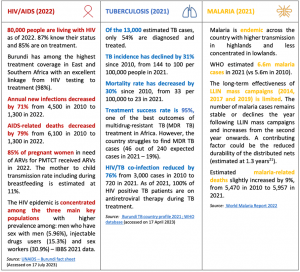
Preventive measures were taken by the Government to slow the spread of COVID-19. Although there was no confinement of the population, the impact of COVID-19 was felt through lower attendance rates at health facilities and delays in the implementation of certain programmatic activities, notably those requiring meetings or workshops. Cumulatively, from the start of the pandemic until April 2023, the case fatality rate was 0.03%
Audit objectives and scope
The objectives of the audit were to assess the adequacy and effectiveness of:
- Timely implementation of interventions for HIV, TB and malaria to ensure access to quality services by beneficiaries;
- Controls and processes in place to ensure continuous availability of quality-assured health commodities and accountability across the supply chain; and
- Governance, oversight mechanism and implementation arrangement in place to ensure accountability, as well as timely and effective implementation of grant activities.
The audit covered the PRs and SRs of Global Fund-supported programs but financial management of the PR, UNDP, was not included in the audit according to UN single audit rule.
First Finding
The first finding is that Burundi’s HIV treatment cascade stands at 87–85–79 in 2022, compared to the 95–95–95 2025 targets set by UNAIDS. This good result has led to the reduction of HIV-related deaths by 79% and new infections by 71% from 2010 to 2022. However:
- Low antiretroviral therapy (ART) coverage for children has resulted in a disproportionate number of new HIV infections;
- Late enrolment of pregnant women in ART may be reducing the effectiveness of prevention of mother-to-child transmission;
- HIV prevalence among key population has significantly increased over the years, raising questions about the effectiveness of prevention activities;
- Despite the high TB treatment success rate, case notification remains low, slowing the reduction of TB mortality; and
- The continuous increase of malaria incidence calls into question the effectiveness of the current strategy.
Second Finding
The latest long lasting insecticidal net (LLIN) mass campaign distribution was completed in September 2022 after a three-month delay. The second finding is that, from a programmatic standpoint, the LLIN mass campaign was successful considering its immediate impact. Malaria cases dropped by 53% from 1.21 million in the first nine weeks of 2022 to 0.57 million for the same period in 2023. However, in terms of governance and oversight, the OIG identified four significant issues which might have resulted in potential diversion or overdistribution of at least 500,000 LLINs: (i) 176,000 households were not served, representing around 500,000 LLINs not distributed as planned; (ii) only partial distribution of LLINs to special groups, with 464,560 LLINs unaccounted for; (iii) an underestimated balance of remaining LLINS; and (iv) the intra-site transfer of LLINs was not properly documented. This matter been referred to the OIG Investigation Unit for further evaluation.
Third Finding
The third finding is that the supply chain system is effective in achieving three key objectives supporting responses to the three diseases: continuous drug availability, limited expiries, and drug traceability. However, there is a need to improve the storage and the ongoing logistic management information system (LMIS) project.
Fourth Finding
The fourth finding is that implementers have limited capacity to plan, coordinate and monitor grant activities. Limited staffing capacity and need for better processes of UGADS have resulted in low absorption of grant fund; and there is a need to strengthen the planning, coordination and supervision capacity of UNDP’s Project Management Unit (PMU), as well as SR capacity.
The report notes that: (i) UNDP’s PMU failed to expediently implement the management actions arising from performance letters and reports: only one of the 10 management actions due in September 2022 was fully implemented; and (ii) one of the key responsibilities assigned to UNDP already during the previous funding cycle was to ensure that the SRs' capacity is strengthened but this remains materially incomplete.
Audit conclusions
In terms of the audit objectives, OIG’s overall assessment was that:
- The adequacy and effectiveness of timely implementation of interventions for HIV, TB and malaria is
partially effective
.
- The adequacy and effectiveness of processes and controls to ensure availability of health commodities and accountability across the supply chain is
effective
.
- The adequacy and effectiveness of oversight and governance of the implementation of grant activities is
partially effective
.
Agreed Management Actions
To address the first finding by 31 December 2024, the Global Fund Secretariat will work with the MOH, development partners and implementers to:
- Increase the proportion of children under 15 years old living with HIV who have been diagnosed by revising the index resting approach to include home-based testing as an option;
- Improve retention on ART of pregnant and breastfeeding women living with HIV through the mentor mother’s approach;
- Boost notification of TB cases via strengthening community-based interventions; and
- Consider a differentiated approach across districts for the next funding cycle by leveraging the malaria risk stratification.
To address the second finding by 31 December 2024, the Global Fund Secretariat will work with the MOH and implementers to:
- Establish an assurance framework over each key milestone of next LLIN campaign;
- Complete the post distribution survey for the 2022 LLIN mass campaign; and
- Conduct end-to-end reconciliations of LLIN stock transactions (from central level down to the distribution points) for the 2022 mass campaign.
In view of the ongoing LMIS project, it was agreed that no AMA was required to address the third finding.
To address the fourth finding by 30 June 2024:
- The Global Fund will work with the Country Coordinating Mechanism (CCM), MOH and implementers and partners to support the delivery of the capacity building plan for UGADs/SRs by the CCM and MOH and prioritize critical activities for resource mobilisation.
- The Global Fund Secretariat will request that UNDP:
-
- updates and strengthens its planning and grant management processes to enhance its financial and programmatic effectiveness;
- updates and secures CCM and SR endorsement of the SRs capacity building plan; and
- provides updates on the SR capacity building activities implemented.
Commentary
Given Burundi’s COE and ASP status, this report is encouraging; and the decreases in new HIV infections, AIDS-related deaths, and TB incidence and mortality that have been achieved are a testament to the continuous efforts by the MOH, the Global Fund and partners to fight these diseases.
The issues concerning the LLINs have arisen in many countries. Surely by now there should be a standard documented set of procedures for reconciling, controlling and reporting in the distribution of LLINs that should be applied universally?
The only surprise in this report is to learn about the weaknesses in UNDP’s planning and grant management processes and the long delay in the adoption and implementation of an SR capacity training program. This is of concern for two reasons. First, UNDP is a PR in many countries where national capacity is considered insufficient to take on the PR role – and this may now call into question UNDP’s suitability to perform that function, especially where UNDP’s selection has already been challenged. Second, there has always been a need to develop national capacity and yet there continues to be insufficient attention to address this. Why is that?
Also of concern is that the Global Fund can do no more than request that UNDP takes the recommended actions to address the fourth finding. That request should already have been submitted; but the Secretariat has no control over whether or not UNDP completes the recommended actions in the time stipulated. We shall await with interest to learn what happens.
Tags:
Leave a Comment
Comments
No comments yet. Be the first to comment!