Breaking Through the Noise: A Critical Analysis of the Global Fund's 2023-2028 Strategic Performance Reports
N/A
ABSTRACT
This article examines the Global Fund’s 2023-2028 Strategic Performance Reports, incorporating insights from constituency feedback gathered during recent Strategy and Executive Board meetings. While the reports highlight progress in HIV, TB and malaria service delivery—such as viral load suppression and TB notifications recovery—persistent gaps remain in equity, gender equality, and pandemic preparedness. Constituencies have emphasized the need for actionable solutions, such as addressing structural barriers, enhancing community engagement, and integrating climate-health resilience. This piece also critiques repetitive and overly generalized reporting, proposing the inclusion of specific examples, such as systemic challenges affecting LGBTQ+ populations and cross-border malaria elimination. To meet its ambitious 2030 goals, the Global Fund must prioritize honest reflection, equitable resource allocation, and stronger partnerships with civil society and local stakeholders. Visual and data-driven assessments underscore where progress has been made and where significant work is still required.
Introduction: The Global Fund’s 2023-2028 Strategy in Focus
The Global Fund's
2023-2028 Strategic Performance Reports
set out a detailed roadmap for achieving progress on the Fund’s core mission: to end HIV, TB and malaria as epidemics while building resilient and sustainable health systems worldwide. In reviewing these reports, however, it becomes clear that while progress has been made in many areas, there are several persistent gaps and challenges that could undermine the Global Fund’s ability to meet its ambitious targets by 2030. These reports, including the
Strategic Performance Summary
, the
Strategic Performance Detailed Report
, and the
KPI Framework Adjustments
, reveal both areas of success and areas of concern that warrant a deeper analysis.
The Global Fund's tendency towards verbose and often repetitive reporting risks obscuring critical insights. This analysis aims to cut through that noise, emphasizing where real progress is being made and where the Global Fund may be sidestepping key challenges—particularly around equity, human rights, incidence reduction, and the integration of gender-focused interventions.
Mixed Progress in Service Delivery: Meeting Some Targets, Missing Others
2023-2028 strategy
underscores the Global Fund’s post-pandemic recovery efforts, with many of the
service delivery KPIs
for 2023 showing strong performance. Notably, the Global Fund emphasizes that it has saved
65 million lives
by the end of 2023, a significant achievement that underscores the continued relevance of its investments across HIV, TB and malaria programs. However, despite these successes, the underlying reports reveal deeper issues that could derail the Fund’s longer-term goals. In Malawi, integration of cervical cancer screening into HIV programs across 75% of antiretroviral therapy facilities demonstrates how resource constraints can be managed effectively with innovative approaches. Similarly, Nigeria’s TB program increased case findings by 26% through community outreach, providing a model for addressing service delivery gaps.
Advanced HIV disease (AHD) continues to drive mortality rates, requiring immediate focus. The Global Fund has scaled up
urine LAM testing
, particularly for TB diagnosis in immunosuppressed individuals, and is expanding access to
short-course TB preventive therapies (TPT)
. In pediatric care, the launch of the
pediatric-friendly Abacavir/Lamivudine/Dolutegravir (pALD) fixed-dose formulation
is a major step in simplifying ART for children, with rollout supported across over 50 countries.
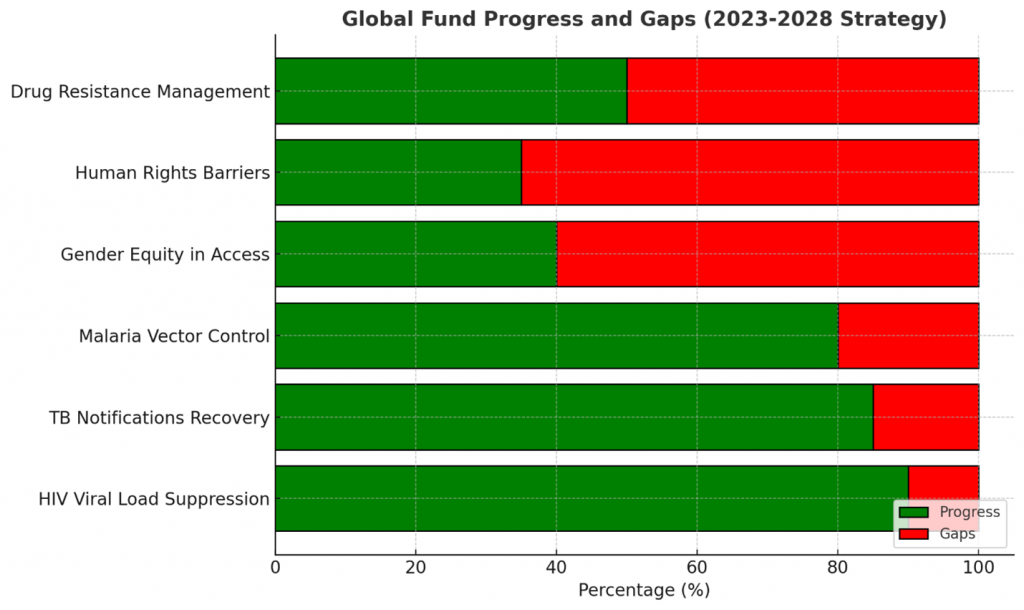
1.1 HIV Performance: Strong but Unequal Gains
The performance indicators for HIV show positive progress across multiple areas.
Viral load suppression rates (KPI H3)
are high, particularly among those tested. Moreover,
adolescent girls and young women (AGYW)
reached by prevention programs (KPI H5) have also exceeded targets. This progress is credited to the
standardization of ART regimens
and expanded
community-based testing strategies
, which have helped close the gap in the “first 95” of the
HIV treatment cascade
—getting people diagnosed and linked to care.
However, as successful as these interventions are, they mask a deeper problem:
equity gaps
in access to treatment and care persist, particularly among
key populations
and
children living with HIV
. Pediatric HIV treatment, for instance, remains far behind adult treatment coverage, contributing to higher rates of HIV-related mortality in children. This suggests that while the Global Fund is scaling up its interventions, it is struggling to reach the most vulnerable, often marginalized, populations.
1.2 Tuberculosis: Strong Notifications, Persistent Gaps
The Global Fund reports a significant recovery in
TB notifications (KPI T1)
post-pandemic, with the highest number of notifications ever recorded in 2023. This recovery is attributed to
innovative service delivery models
, including greater
community engagement
and
decentralization of services
. Yet, despite this recovery, the report highlights several key challenges:
TB treatment and prevention gaps
persist, particularly in funding for
preventive therapy (KPI T5)
, which has fallen far short of targets.
- The
decentralization of services
, while effective, is hampered by
commodity shortages
, particularly in
TB diagnostics
and
first- and second-line treatments
, especially in high-burden countries.
- In countries like India, which constitute large parts of the TB burden, data is not yet fully integrated into performance evaluations, leading to potential underreporting of both successes and gaps.
This paints a picture of a TB program that is moving in the right direction but still faces considerable challenges—especially in ensuring equitable access to treatment and prevention for hard-to-reach populations.
1.3 Malaria: Strong Vector Control, But Resistance Looms
For malaria, the distribution of
insecticide-treated nets (ITNs)
has been a major success, with 227 million ITNs distributed, covering 96% of the target population. Likewise, performance in
malaria testing (KPI M2)
and treatment has remained strong across both public and private healthcare settings.
However, emerging
artemisinin resistance
in East Africa poses a severe threat to malaria control efforts. While the Global Fund is working on diversifying
artemisinin-based combination therapies (ACTs)
, including the deployment of
multiple first-line therapies (MFT)
, it is constrained by the high cost of newer treatments and the overall
fiscal limitations
within many country programs. Furthermore, performance on
IPTp3 (intermittent preventive treatment during pregnancy, KPI M4)
was weaker, driven in part by low utilization of antenatal care in some regions.
This suggests that while the Global Fund is making strong progress in vector control and case management, it is vulnerable to emerging drug resistance and struggles to address health system gaps that prevent pregnant women and other vulnerable groups from accessing critical preventive treatments. Data-driven malaria interventions are advancing subnational elimination efforts. These include tailored campaigns integrating
nutrition screening and vitamin A supplementation
, which enhance health outcomes while addressing local context-specific needs.
Equity, Gender, and Human Rights: Slow Progress on Critical Fronts
equity, gender inequality, and human rights
barriers. These issues are central to the Global Fund’s strategy, yet progress here has been
uneven and incomplete
.
Gender equity remains a cornerstone of Global Fund strategies. Through the
Global Alliance to End AIDS in Children
, targeted investments in antenatal care and early infant diagnosis are bridging service gaps in regions like West and Central Africa. Investments in harm reduction programs for people who use drugs also underscore a growing focus on underserved key populations.
2.1 Community Engagement and Gender Equality
The Global Fund has repeatedly emphasized the importance of
community engagement
in improving health outcomes. Yet, the reports indicate that performance on
community engagement KPIs
is well below target. For example, the
community engagement target (75%)
has not been met, even though it was expected to be achieved in the
first stage
of the funding cycle. This failure is particularly troubling given the Global Fund’s repeated commitment to ensuring that communities are empowered to take an active role in
health governance and service delivery
.
Similarly, while the Global Fund has increased its focus on gender equality, progress has been slow, particularly in addressing legal and policy environments hostile to LGBTQ+ rights. For instance, South East Asia emphasized that one-third of people with HIV lack access to life-saving treatments. The
KPI for gender equality
continues to lag far behind the expected targets, particularly in countries where
legal and policy environments
are hostile to gender equality and LGBTQ+ rights. Stakeholders at the 51st Board meeting had raised concerns that the Global Fund is not doing enough to
move beyond expressions of concern
regarding
human rights violations
, urging more active intervention and advocacy. This continued at the 52nd Board meeting as well. The call to
enhance gender equality initiatives
, particularly in regions facing
backlash against gender equity
, reflects the need for stronger actions beyond simply meeting numerical targets.
2.2 Structural Barriers to Access
Persistent
structural barriers
, including
stigma
,
discrimination
, and
criminalization
, continue to hinder access to HIV, TB and malaria services. Constituencies have called for an ombudsperson and mandatory CCM inclusion to address these barriers more systematically.
Legal barriers
around LGBTQ+ rights in some countries prevent effective health interventions, and the Global Fund’s strategy for addressing these issues remains underdeveloped. Similarly,
gender-based violence (GBV)
and
gender inequality
remain significant barriers to accessing HIV prevention and treatment, particularly for women and girls in sub-Saharan Africa.
Despite the Global Fund’s emphasis on human rights and equity, these barriers are being tackled slowly, and the
low prioritization
of community engagement suggests that more needs to be done to incorporate
local voices
and
civil society actors
into the decision-making process.
Constituency statements highlighted critical areas for improvement in tackling human rights challenges and gender barriers. For instance, the persistent stigma and discrimination faced by key populations, including people who use drugs and those in mental health facilities, which continues to impede access to TB and malaria services. The importance of strengthening governance structures to promote the meaningful inclusion of marginalized populations in decision-making processes was also underlined.
Constituencies highlighted the intersection of climate crises and health inequities, noting evidence of an 11% rise in HIV transmission during droughts in Africa. Such findings underscore the need for integrating climate resilience into the Global Fund’s equity-focused initiatives.
2.3 Constituency Insights: Bridging the Gaps
Equity and Human Rights:
Constituencies, highlighted the need for intensified collaboration with civil society to address barriers like stigma, discrimination, and legal challenges that hinder equitable healthcare access.
Gender Inequity:
Constituencies reiterated the lack of specifics in the Global Fund's gender equity reporting. While gender-focused funding (46% of GC7 allocations) was noted, significant gaps in actionable progress, especially in key populations, remain a concern.
Pandemic Preparedness:
Constituencies stressed the need for robust health information systems and alignment with climate-health frameworks to sustain progress. Concerns about short implementation timelines for COVID-19 Response Mechanism (C19RM) investments were also raised.
Funding and Sustainability:
Constituencies emphasized better alignment of the Global Fund’s allocation methodology with disease burdens while protecting gains in HIV, TB, and malaria programming. WHO urged the Global Fund to provide transparent guidance on co-financing requirements, ensuring alignment with government budget cycles and enabling better planning for domestic contributions
Pandemic Preparedness and Resilient Systems for Health: A Work in Progress
pandemic preparedness
and
resilient health systems
. The reports highlight that while the Global Fund is working to strengthen
health management information systems (HMIS)
and enhance
health system resilience
, there is still a long way to go before these systems are fully robust.
Constituencies emphasized the importance of aligning National Adaptation Plans with health systems to tackle vulnerabilities arising from climate change, proposing that these be linked to future catalytic investments for sustainability and resilience.
3.1 Data Systems and Monitoring Gaps
One of the key challenges in pandemic preparedness is the lack of comprehensive health data systems. Constituencies pointed to supply chain delays and outdated digital systems as additional hurdles to ensuring sustainability in health interventions. While
targeted Health Facility Assessments (tHFAs)
have been initiated in 18 countries. These assessments are integral to monitoring service delivery quality and enhancing preparedness frameworks across high-priority portfolios. However, these assessments are still in early phases, with baseline scores expected to be available only by 2025. The delayed rollout of these assessments is indicative of broader capacity issues that could undermine the Global Fund’s ability to respond swiftly to future pandemics.
Moreover, while the Global Fund reports that
COVID-19 effects
on health service delivery have been mitigated, the slow pace of building pandemic-resilient systems suggests that countries may still be vulnerable to future shocks.
Constituencies reiterated the need for integrating climate-health considerations into health system planning, leveraging the WHO-led Alliance for Transformative Action on Climate and Health (ATACH). This collaboration could address resilience gaps and enhance sustainability, particularly for vulnerable populations in climate-vulnerable regions.
Through strategic procurement, the Global Fund achieved a
25% cost reduction in first-line HIV treatments
and a
30% drop in TB preventive therapy prices
. Such interventions allow countries to expand service delivery while reallocating savings to other pressing health priorities.
Adjustments to the KPI Framework: Changing the Narrative?
2023-2028 KPI Framework
adjustments introduced in the reports indicate that the Global Fund is learning from its past reporting cycles. Key changes, such as
KPI R1b
(which tracks co-financing commitment risks), reflect a shift towards more
cumulative reporting
across the allocation period rather than focusing on year-by-year performance. While this change may provide a more comprehensive picture of progress, it also risks
inflating success rates
by counting delayed actions as completed.
Additionally, the shift to
unweighted averages
for
on-shelf availability (KPI S8)
may obscure country-level disparities by treating all countries equally, regardless of the number of facilities being assessed. These changes could create a
rosier picture
of performance than is warranted, leading to less pressure for action where it is needed most.
Constituencies raised alarms about workforce capacity, noting high burnout rates among Global Fund staff due to excessive workloads and frequent in-country travel demands. These challenges highlight the need for operational reforms to enhance efficiency and sustainability.
Strengthening Country Coordination
Community-focused initiatives such as
Community Pulse
and
CLM+
aim to empower local organizations in grant monitoring and service delivery. These programs emphasize capacity-building and institutionalizing data-driven advocacy. An independent evaluation in late 2024 will assess their long-term contributions to health governance.
Investments of $130 million under GC7 and an additional $81 million from C19RM are supporting the development of a sustainable
community health workforce
. These funds focus on improving training, retention, and deployment to ensure continuity in primary healthcare delivery.
Missed Opportunities and Overlooked Challenges
insufficient
:
The reports focus heavily on
fund utilization
(85% of in-country absorption for GC6 grants) but provide little analysis on whether these funds are being
efficiently
or
equitably
spent. Financial performance needs to be more closely tied to
impact analysis
to ensure that resources are going where they are needed most.
- Discussions on the quality-of-service delivery, particularly in
community health systems
, often
overlook gaps in equitable resource distribution
. For instance, constituencies noted that catalytic investments alone cannot sustainably scale best practices, especially in low-resource settings.
- The reports also gloss over the
root causes
of poor performance in equity, gender, and human rights, instead emphasizing
numeric progress
on KPIs without sufficient reflection on the systemic barriers that are preventing deeper progress.
Constituencies highlighted innovative approaches like Nigeria’s community-driven TB outreach initiative, which increased case findings by 26% compared to the previous year. This illustrates how targeted community interventions can address service delivery gaps effectively. Another instance cited was how Niger successfully integrated grant resources into its national finance laws, facilitating tax exemptions and improving absorption rates above 85% despite fiscal constraints. This approach offers a roadmap for better resource integration across Global Fund-supported countries
.
Funding gaps remain a critical challenge for TB prevention. Tools like contact tracing and preventive regimens (e.g., 1HP) are underutilized due to high costs and limited resources. Without accelerated funding for the targets set during the 2023 UNHLM, TB outcomes will continue to lag.
Conclusion: A Call for More Honest Reflection
The Strategic Performance 2023-2028 reports paint a picture of substantial progress in certain areas, but they also reveal troubling
gaps in equity, human rights
, and
pandemic preparedness
. The Global Fund’s emphasis on
KPI success
often obscures deeper, more systemic issues that are preventing true progress towards
ending HIV, TB and malaria
. While
service delivery
is improving, the
incidence reduction targets
are still far off, and the Global Fund risks falling into a pattern of reporting numbers that tell only part of the story.
For the Global Fund to achieve its
2030 goals
, it must take a more
critical, solution-oriented approach
, focusing not just on meeting numerical targets but on tackling the deeper, systemic challenges that are impeding equitable healthcare delivery. This requires
honest reflection
,
stronger partnerships
with
civil society
, and a deeper commitment to
human rights and gender equality
. Only by confronting these issues head-on can the Global Fund truly achieve its mission of ending the epidemics of HIV, TB and malaria.
For further insights into the Global Fund’s KPI performance and strategic planning, see:
Tags:
Leave a Comment
Comments
No comments yet. Be the first to comment!