Risk Management at a crossroads: Analyzing the Global fund’s strategic approach to challenges in a volatile world
N/A
ABSTRACT
This article reviews the Global Fund's latest Risk Management Report, discussed at the 52nd Board meeting in Lilongwe, Malawi. It examines the challenges posed by external shocks and operational pressures, the organisation's strategies for sustaining impact in the fight against HIV, tuberculosis and malaria, and stakeholder responses.
The 52nd Board meeting of the Global Fund, held from 18 to 22 November 2024 in Lilongwe, Malawi, was marked by a discussion of the organization's risk management strategies, as outlined in the latest Risk Management Report. This document lays bare the pressures facing the Global Fund—from external shocks to internal operational strains—and highlights a path forward as the organization seeks to sustain its impact against HIV, tuberculosis (TB), and malaria in an increasingly unpredictable global landscape.
As the Global Fund charts its course through these challenges, the report underscores the importance of adaptability, collaboration, and strategic innovation. In this article, we look at the report's findings, its implications for the Global Fund and the reactions of the various stakeholders.
The global risk landscape: a complex matrix of challenges
The Risk Management Report emphasizes that the Global Fund operates in a world of unrelenting turbulence. Three interlinked external factors—conflict, climate change, and economic instability—are not just compounding risks but reshaping the very foundations on which the organization operates.
- External funding pressures
Without significant action, this dual squeeze on resources risks reversing gains made against the three diseases, leaving millions without access to life-saving prevention and treatment services.
- Operational strains
The report underscores the need for a twofold approach:
- Refinement of traditional risk management practices to enhance efficiency and stability.
- Adoption of disruptive innovations to ensure that the Global Fund remains agile and impactful in a resource-constrained environment.
Grant-facing risks: progress amidst challenges
Encouragingly, the Global Fund has made strides in mitigating risks directly tied to grant performance. These “grant-facing risks” reflect the organization’s ability to maintain programmatic momentum in the face of external disruptions.
HIV Program Quality: a stabilized success
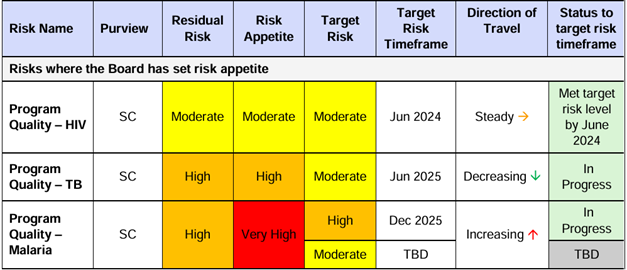
For the first time, the HIV Program Quality Risk has achieved a “Moderate” rating (Figure 1), thanks to strong programmatic performance in high-burden countries and strategic efforts to ensure continuity of treatment and prevention services. Yet, challenges persist in addressing human rights barriers and scaling up prevention services to reach vulnerable populations.
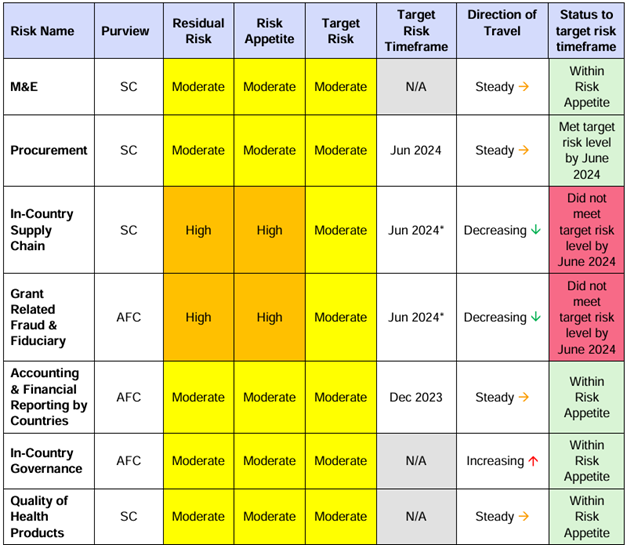
Figure 1: Summary table of risk levels and targets
TB Program Quality: progress with caveats
The TB Program Quality Risk is on a downward trajectory, but achieving the target “Moderate” level by mid-2025 will require closing significant funding gaps. The report warns that without sustained financial and technical support, progress in scaling diagnostic tools and treatment access could falter, particularly in high-burden countries like Nigeria and Bangladesh.
Malaria Program Quality: a rising concern
In contrast, the Malaria Program Quality Risk has seen an alarming increase, driven by climate-induced disruptions, emerging insecticide resistance, and funding uncertainties. While dual-action insecticide-treated nets and innovative strategies offer hope, gaps in program coverage remain daunting.
Non-grant risks: an escalating threat
While grant-facing risks have generally stabilized or declined, non-grant risks—those tied to the internal workings of the Global Fund—are trending upward. These include:
- Workforce capacity and culture: Persistent operational demands are straining the Secretariat’s workforce, leading to risks around efficiency, wellbeing, and morale.
- Governance and oversight: The complexity of navigating multi-stakeholder governance structures is testing the agility of decision-making processes.
- Internal controls: Challenges in aligning streamlined operations with robust oversight mechanisms highlight the need for targeted improvements.
Focus areas for improvement
The Risk Management Report outlines clear priorities for 2024, signaling a commitment to adapt and thrive despite mounting pressures.
- Embedding a risk-aware culture
- Advancing risk analytics and monitoring
- Tailored assurance frameworks
Strategic reflections: navigating a new paradigm
The next 12 months will be pivotal for the Global Fund as it seeks to maintain programmatic gains while positioning itself for the future. The report identifies several strategic imperatives:
Balancing Streamlining and Oversight
Efficiency is crucial, but it must not come at the cost of the robust control mechanisms that underpin the Global Fund’s credibility and effectiveness.
Leveraging Partnerships for Sustainability
Building resilience will require deeper collaboration with local governments, civil society, and other stakeholders. Empowering in-country partners to take greater ownership of health outcomes is a key step toward long-term sustainability.
Innovating for Impact
From adopting novel financing mechanisms to exploring disruptive technologies, the Global Fund must embrace innovation to stretch resources further and address emerging challenges.
Stakeholder feedback on risk management
Stakeholders provided thoughtful and nuanced feedback on the Global Fund's risk management report, reflecting both appreciation for progress and concern about ongoing challenges. A primary area of focus was the ambition to achieve moderate malaria risk levels by 2025, which stakeholders felt may be jeopardized by limited resources and persistent geopolitical challenges. They emphasized that achieving this target requires intensified country-specific dialogues, particularly with government stakeholders, to align collective efforts and address critical funding gaps.
While the report acknowledged progress in challenging operational environments, stakeholders highlighted that residual risks remain significant. One key concern was supply chain management, where enhanced national ownership and governance were seen as essential for long-term sustainability. Stakeholders underscored the need for stronger national stewardship to mitigate these persistent risks effectively.
The importance of operationalizing robust, country-specific risk management systems was a recurring theme. Stakeholders stressed that building national capacity and ownership is fundamental to sustaining progress. They also recommended that future risk assessments integrate metrics assessing how health programs align with and support broader national systems, ensuring a more holistic approach to sustainability.
Another point of discussion was the improved performance metrics reported by the Global Fund. While these advances were appreciated, stakeholders sought greater transparency regarding how these gains could be sustained amid mounting fiscal pressures and a challenging global context. They called for clearly articulated strategies to preserve these outcomes while addressing rising human rights concerns and external financial constraints.
Collaboration emerged as a critical priority. Stakeholders emphasized the importance of deepening partnerships with national governments, civil society, and international organizations to strengthen programmatic and operational outcomes. Such partnerships must focus on building resilient and inclusive systems capable of withstanding external shocks.
Finally, stakeholders stressed the importance of refining the Global Fund’s risk appetite framework to account for the volatility of external environments. They advocated for a balanced approach that safeguards programmatic imperatives while managing fiscal and reputational risks. These refinements should be both adaptive and forward-looking to address emerging challenges effectively.
Conclusion
The Risk Management Report is both a wake-up call and a roadmap for action. It highlights the stark realities of a volatile global environment while offering a clear vision for how the Global Fund can navigate these challenges.
The collective feedback underscores the need for continued innovation, partnership, and responsiveness in risk management strategies to maintain progress and advance the Global Fund's mission in an increasingly complex global landscape.
As the organisation looks to the future, its success will indeed depend on its ability to adapt, collaborate and innovate. By staying true to its mission and maintaining a relentless focus on impact, the Global Fund can ensure that its hard-fought gains are not only preserved but expanded—bringing hope and health to millions around the world.
Tags:
Leave a Comment
Comments
No comments yet. Be the first to comment!