Antimicrobial resistance: Focus on Africa
N/A
ABSTRACT
With antimicrobial resistance becoming a pressing global health and developmental problem, Africa, which has the highest mortality due to AMR is poised to show the way on how it is to be tackled. The African Union AMR Landmark Report outlines the threat and priority actions to tackle it. Its recommendations and research studies are covered in this article.
Antimicrobial Resistance – A Global Problem
Antibiotics are the go-to meds for preventative treatment and curing bacterial infectious diseases across human, plant and animal life. However, their large-scale misuse has led to the World Health Organization declaring antimicrobial resistance (AMR) as a global health and development problem. A peek at a compilation of research studies (Figure 1) presented in 2024 shows how widespread is this threat.
Figure 1: Selected studies on antimicrobial resistance (AMR) bacteria from animals and their products and foods.
Country of origin |
Food sample |
Antimicrobial resistance |
|
Bangladesh, China, India, Philippines |
Vegetables, pepper leaves, spinach, stolon of taro, hyacinth bean seeds, sweet potato leaves, etc. |
Staphylococcus aureus (S. aureus), Escherichia coli, (E. coli) Klebsiella pneumoniae, (K, pneumoniae) Enterobacter cloacae, (E. cloacae) Enterobacter aerogenes, (E. aerogenes) |
|
China, Vietnam, Pakistan |
White pepper powder, ginger powder, and Szechuan pepper |
Salmonella Enteritidis |
|
Egypt, Brazil, Vietnam |
Poultry, rabbit meat |
Salmonella Weltevreden; E. coli |
|
Italy |
Venus clam |
E. coli |
|
Brazil, Argentina |
Poultry meat |
Salmonella Heidelberg |
|
Brazil, China, Poland, Germany |
Turkey meat/liver |
K. pneumoniae, E. coli, Citrobacter braakii (C. braakii) |
|
Vietnam |
Shrimp |
Vibrio parahaemolyticus (V. parahaemolyticus) |
|
Iran |
Raw bovine milk |
S. aureus E. coli, Listeria monocytogenes (L. monocytogenes), and Salmonella spp. |
|
Thailand (different selected areas) |
Pigs, broiler, fish, etc. |
ESBL-producing E. coli |
|
China |
Raw milk, cooked food products, and raw meat |
Salmonella, L. monocytogenes, and S. aureus |
Africa |
Poultry products |
Campylobacter jejuni (C. jejuni), Campylobacter coli (C. coli), Campylobacter lari (C. lari) |
|
Sri Lanka |
Poultry meat and neck skin |
C. jejuni, C. coli |
|
Cuba |
Meat products, dairy products, etc. |
Salmonella, E. coli, Vibrio cholerae, (V. cholerae) Staphylococcus |
|
Pigs |
Methicillin-resistant S. aureus (MRSA) |
|
|
Netherlands (Southern) |
Catfish and eel farms (aquaculture) |
Aeromonas |
Ethiopia |
Animal-origin food (e.g., egg sandwiches, raw milk, and raw meat) |
Salmonella spp. |
|
ginger root, garlic powder |
Bacillus spp., Stenotrophomonas maltophilia Erwinia spp., E. cloacae, Ewingella americana, E. americana and Staphylococcus spp. |
Source:
Antimicrobial resistance containment in Africa: Moving beyond surveillance, Biosafety and Health, Volume 6, Issue 1, February 2024, Pages 50-58.
Even as AMR sweeps across the globe, the worst impacts are felt in low- and middle-income countries, especially sub-Saharan Africa and South Asia. This article focuses on the former.
AMR and Africa
Antimicrobial resistance (AMR) is now the leading cause of mortality in the African region. This fact was reiterated by Dr. Jean Kaseya, Director-General, Africa CDC at the Global Forum for Vaccine Sovereignty and Innovation. He mentioned that he had in fact raised the issue of including AMR in the Global Fund with its CEO, Peter Sands given that it kills more people than HIV, TB and malaria put together. In 2019 the overall mortality in Africa stood at an approximate 255,000 deaths. The global spend on AMR despite its potentially higher death burden does not match the estimates for needed funding (Figure 2).
Figure 2
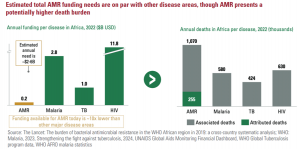
To address this threat, the Africa region adopted the AMR Global Action Plan and the African Union Framework for Antimicrobial Resistance Control 2020 – 2025. The Voicing African Priorities on the Active Pandemic: African Union AMR Landmark Report brought out by the Africa Centres for Disease Control and Prevention (CDC) points out that despite National Action Plans prioritizing tackling AMR, given that its negative impact impinges on health across human, animal, aquatic, plant life and the environment as a whole (Figure 3), it’s always going to be an uphill task to adequately address the magnitude of the AMR threat.
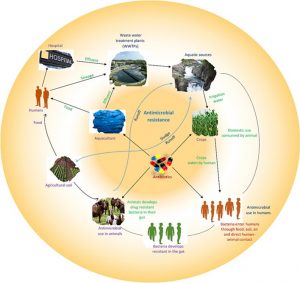
Figure 3: Transmission routes of antibiotics, resistant genes and drug-resistant bacteria
“The transmission routes of antibiotics, resistance genes, and drug-resistant bacteria. Antibiotic-resistant bacteria and their associated genes can be transmitted in various ways. Over-prescription, patients not completing treatment, lack of diagnosis, unclean facilities, and poor infection control all contribute to the emergence of resistance. Lack of proper diagnosis can lead to inappropriate or wrong choice of drug for treatment. Antibiotics are also used in aquaculture, crop farming, and even animal husbandry. These drugs are not completely used by animals, as certain levels remain and can be transmitted to humans when consumed. Overall, bacteria enter humans through food, soil, air, and direct human-animal contact. Effluents from aquaculture also contribute to the accumulation of resistant pathogens and bacteria in wastewater treatment plants.”
Source:
Antimicrobial resistance containment in Africa: Moving beyond surveillance, Biosafety and Health, Volume 6, Issue 1, February 2024, Pages 50-58.
AMR’s Impact on SDG Goals in Africa
The African Union AMR Landmark Report goes on to point out it’s not just morbidity and mortality that is of concern when talking of AMR. But the attainment of the 2030 Sustainable Development Goals (SDG) such as Universal Health Coverage (UHC), poverty elimination, health for all, gender equality and economic prosperity are also in jeopardy from AMR. Furthermore, major advances in medical care such as in cancer, treatment of infectious diseases, performing complex surgeries, maternal and child health, all stand to be endangered by the threat that AMR poses. And what is alarming is that by 2050, the projected AMR-related deaths will increase fourfold to touch a whopping 4.1 million annually as the population in Africa is set to double.
While Africa has lagged behind in committing 15% of national budgets towards health as per the Abuja Declaration as well as in attaining the SDG goals, 57% of African countries have incorporated into their National Essential Medicine Lists (NEMLs) the AWaRE (Access, Watch, Reserve) classification of antibiotics and nearly half the countries in the region have implemented integrated surveillance systems for AMR. Further, 48% of the countries in Africa have rolled out or initiated multisectoral coordination using the One Health approach.
The research study Antimicrobial resistance containment in Africa: Moving beyond surveillance noted that the African region is on the verge of complete eradication or elimination of polio, maternal and neonatal tetanus. However, more than 30 million children under the age of five continue to suffer from vaccine-preventable diseases (VPDs) annually in Africa. Expanding access to vaccination is therefore crucial. Innovation in this area could well be applied to address other AMR issues in the future as well.
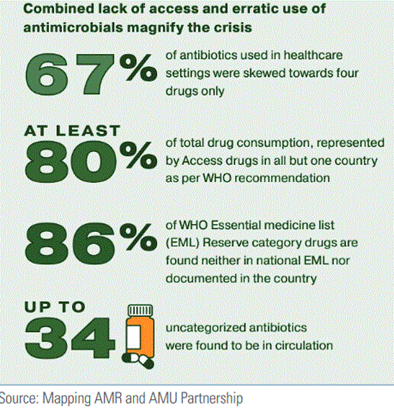
The issue of lack of access to vaccination is also contiguous with lack of access to antibiotics. So, often, when there is a shortfall in available antibiotics it leads to opting for whatever is easily available although these should not actually be even used as a first line of treatment. Studies have also found that an estimated 70% antibiotics are distributed sans any prescription, compounding the problem as this naturally increases the possibility of AMR resistance developing (Figure 4).
Figure 4: Impact of limited access and erratic use of antibiotics in Africa
Is Africa a Priority in the WHO Pathogens List?
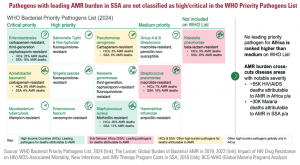
However, there is also a problem with the WHO Priority Pathogens List (Figure 5), which does not classify the pathogens that are critical in the African context. This lack of alignment with the needs of Africa means that in a situation of constrained resources, even less will get directed where they’re actually needed.
Figure 5: Priority Pathogens in Sub-Saharan Africa versus WHO Global Priority List
However, the attendant issue is also of the paucity of research aligned with Africa’s needs. A 14-country research study in 2022 conducted by the Mapping Antimicrobial Resistance and Antimicrobial Use Partnership (MAAP) found that only five of 15 antibiotic-resistant-pathogens designated by the WHO as priority pathogens are consistently tested. Geetanjali Kapoor, head of One Health Trust, India who was cited in the article on this study pointed out that the paucity of testing of all 15 indicates the likelihood that the data on AMR levels is being underestimated. This will have a direct bearing on patient care. Moreover, as Nqobile Ndlovu, CEO of ASLM who is also quoted in the article said, “Across Africa, even where such data is collected, it is not always accessible, often recorded by hand and rarely consolidated or shared with policy makers. Health experts are flying blind and cannot develop and deploy policies that would limit or curtail antimicrobial resistance.”
The Way Forward
The African Union AMR Landmark Report outlines a set of priority actions to address the AMR crisis:
- Strengthen Governance and Leadership
- Control and Reduce AMR Drivers in Africa
- Build Evidence and Improve Reporting
- Mobilize and Coordinate Resources
- Strengthen Community Engagement and Education
- Enhance Research and Innovation
A research study made the following specific recommendations to address the challenges faced when implementing AMR prevention measures.
Recommendation |
Strategies |
Increasing the public’s knowledge of antibiotics and antimicrobial resistance as well as promoting antibiotic stewardship |
• Open communication about AMR between Health Care Workers and the public • Educating the public about AMR through various communication channels • Development of evidence-based guidelines for antibiotic prescribing • Continuous education on antibiotics for healthcare workers (HCWs) and veterinarians • Building laboratory capacity and promoting diagnostic stewardship |
Effective AMR surveillance and collaboration |
• Development of national AMR surveillance plans • Dissemination of AMR surveillance data for decision and policy making • Implementing One Health approach • Collaboration with high-income countries • Training more laboratory scientists and offering them a competitive remuneration |
Regulatory enforcement and restricting antibiotics promotion |
• Medicine regulatory authorities should be adequately funded and should be autonomous. • Prohibition of the sale of antibiotics over the counter • Prohibition of unnecessary promotion of antibiotics by pharmaceutical companies |
Improve the practice of infection prevention and control (IPC) measures |
• Improve water and sanitation infrastructure in the region. • Promoting immunization against infectious diseases • Educating the public about IPC • Frequent inspection of food outlets and healthcare facilities |
Source:
Prevention of antimicrobial resistance in sub-Saharan Africa: What has worked? What still needs to be done?, Journal of Infection and Public Health, Volume 16, Issue 4, April 2023, Pages 632-639.
Conclusion
The issues related to vaccine acceptance and the growing antimicrobial resistance as mentioned earlier have their roots in the lack of confidence in local products and absence of research studies and trials within Africa. At some point, it is pertinent to ask why it is that despite repeated talk about collaborations, at the primary health centres that form the foundational basis of universal health coverage, there is no coherence between educating about AMR while pushing for vaccination because it is vaccination that can protect against infectious diseases and stave off the necessity of antibiotic treatment for them later.
How Africa deals with the threat of AMR will determine the future direction for the rest of the globe. For it is at the cusp of phenomenal growth, with its large youth cohort, its drive towards local manufacturing, its drawing up of national plans, templates and coordinating mechanisms for regional cooperation, all of which can be a game changer in adapting as well as innovating not just vis-à-vis AMR but in retooling its strengthening of health systems. Will Africa seize its moment? The world will be watching what it presents at the UN General Assembly-convened High-Level Meeting on antimicrobial resistance (AMR) for the second time during its 79th session (UNGA 79) in New York on September 26, 2024. The world hopefully will pay heed.
Tags:
Leave a Comment
Comments
No comments yet. Be the first to comment!