Here’s looking at the RISE study on Country Coordinating Mechanisms: Next Steps and what can we learn from it?
N/A
ABSTRACT
The RISE study is an independent study by organizations across eleven countries, who came together to collectively decide the contours of the research they were to undertake of the Country Coordinating Mechanisms (CCMs) of the Global Fund. This article focuses on what went on behind the scenes of that first meeting in Damascus and the history and evolution of the CCM within the Global Fund structure and ends with the roadmap and recommendations from the RISE study group.
Notes from Casablanca where it all began…
Thirteen activists and researchers from eleven different countries put the final touches of sugar and milk into their coffees and took their places at a large wooden table in Casablanca, Morocco. The journey to this meeting was very long for some, with partners making their way from Cameroon, Burkina Faso, France, Kenya, Malaysia, Mozambique, Thailand, South Africa, Uganda and the United States. We did not speak the same language, and we had never worked together before, but our task was clear: we wanted to plan a global research study on Global Fund Country Coordinating Mechanisms (CCMs). Over the course of the week, these activists and researchers formed a steering committee who worked together across languages, countries, and cultures to build a study to measure the topics most important to the community. We co-designed each indicator, discussed each methodological decision, and debated differences of opinions. It was an impressive display of democracy rarely applied to research design. At the end of the week, we had to decide what to call ourselves. After all, every study needs a name. We voted by majority to be the RISE study group, standing for Representation, Inclusion, Sustainability, and Equity in CCMs and Global Fund Processes. It was there, during the candid discussions over the Moroccan cuisine of couscous and tagine in early 2023, that we started the journey to bring community driven data to Global Fund decision-makers[1].
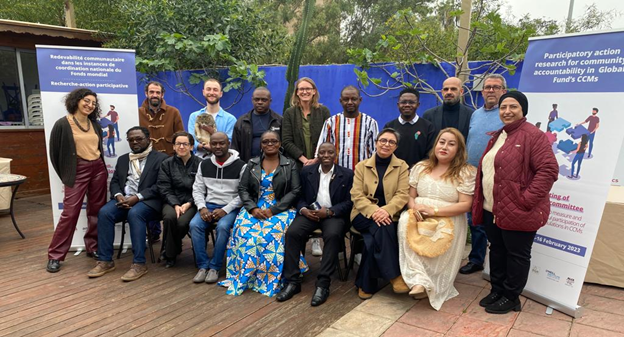
First RISE Steering Committee meeting in Casablanca, Morocco February 2023.
Participants include Ghita Zaoui (Association de Lutte Contre le Sida), Daniel Simões (Coalition PLUS), Léo Deniau (AIDES), César Mufanequico (MATRAM), Jennifer Sherwood (amfAR), K. Victor Ghislain Some (REVS PLUS), Serge Douomong Yotta (Coalition Plus), Samir Fakhar (interpreter), Mohammed Elkhammas (Association de Lutte Contre le Sida), Nadira Regrag (interpreter). (Seated, left to right): Fogué Foguito (Positive Generation), Alana Sharp (O’Neill Institute for National and Global Health Law), Peter Njane (Ishtar MSM), Sibongile Tshabalala (Treatment Action Campaign), Kuraish Mubiru (Uganda Young Positives), Naoual Laaziz (Association de Lutte Contre le Sida), and Thitiyanun Nakpor (Sisters).
We weren’t starting from scratch; in fact, the Global Fund has a long history of seeking community input into its key processes and programming.
History of CCM Strategy
In its 2023-2028 Strategy, the Global Fund was unequivocal: the meaningful engagement of communities is not optional, it is an absolute requirement. The leadership of communities most affected is a core pillar of the entire program, it is like one leg of a chair; without it, the entire structure will fall. One key way that communities have to engage with the Global Fund is through the Country Coordinating Mechanism (CCM). The CCM is the multi-stakeholder body in charge of writing the Funding Request, selecting Principal Recipients (PR), and overseeing grant implementation. CCM representatives include members of all sectors involved in the response including community, civil society, multilateral and bilateral agencies, academic institutions, private sector, and government. According to the Global Fund, the CCM is one of the cornerstones of the entire model, a true example of multi-sectoral democracy that intends to give each member equal voting power.
In reality, however, there is a wide variety in the level of CCM openness and functioning, with some CCMs being very complicated spaces for community engagement. Community members may be limited by resources, power differentials, and lack of access to information. Indeed, designing and overseeing large, multi-disease grants is technically challenging, very time-consuming, and community members often have full-time jobs elsewhere. Power dynamics in the CCM can make advocating for the needs of communities difficult, particularly since nearly every country with a CCM has some form of criminalization of key populations. Being a key population member of the CCM can mean opening yourself up to bullying, intimidation, or forced outing of LGBT status in a hostile country context.
To improve CCMs, the Global Fund has invested in the CCM Evolution Pilot and the Strategic Initiative, which focused on improving CCM oversight, engagement, positioning, and operations. While the CCM Hub continues its work, the Strategic Initiative ended in 2023. To empower and support communities to engage with the CCM, the Global Fund introduced three “Minimum Expectations” for community engagement at the November 2022 Board Meeting. The expectations are that: 1) communities are consulted during Funding Request development; 2) community CCM representatives receive “information on the status of grant negotiations”; and 3) community CCM representatives have “timely access to information on program implementation.”
The extent to which these minimum expectations are being met is a very important question for communities - one that the RISE study intended to answer through a global study.
The RISE Study Results – A Summary
Specifically, the RISE study measured community participation, engagement, and power on the CCM from the perspectives of community members on and off the CCM.
Through an 83-country survey reaching over 600 participants and in-depth interviews of nearly 50 additional participants, the RISE study showed many positive examples and some widespread difficulties with community engagement. Overall, the study found a broad approval of the CCM model, with respondents noting that in most countries the CCM is the only space where communities can sit in the room with government officials and donors and make decisions about the health system. RISE data also showed numerous strategies that community CCM members were employing to make their voice heard on the CCM, such as holding civil society pre-CCM meetings or writing shadow reports to the Global Fund if the submitted Funding Request did not adequately reflect community views.
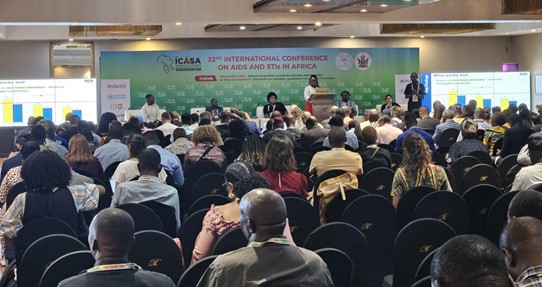
Presentation of the RISE findings at ICASA in Harare (December 2023)
However, participants in the study highlighted challenges to meaningful participation:
Challenges faced by CCM representatives
- First, communities were not well engaged in the decision-making process at later parts of the grant cycle. Participation greatly dropped off after Funding Request development and communities were less likely to be involved in budgeting and oversight tasks on the CCM than non-community CCM members.
- Secondly, community members were not always equipped with the tools and resources they needed to actually participate in CCM matters. This includes gaps in funding and reimbursement of their expenses, delays in necessary documents, data, and reports, non-availability of translated documents, lack of accessible oversight data, and gaps in the training and support to build the skills needed for CCM engagement.
- Finally, communities are suffering widespread discrimination and intimidation on CCMs that requires an immediate response. We must all work to ensure communities are empowered to have a voice in the CCM. This must include ensuring that everyone is safe to speak up, and to prevent stigma, discrimination, intimidation, and retaliation.
Full results are available in the RISE report, published on April 22nd 2024.
RISE Study in international fora
RISE results have been shared in several international venues including the International Conference on AIDS and STIs in Africa (ICASA) in Zimbabwe in December 2023 and as part of a skills building workshop at AFRAVIH in Cameroon.
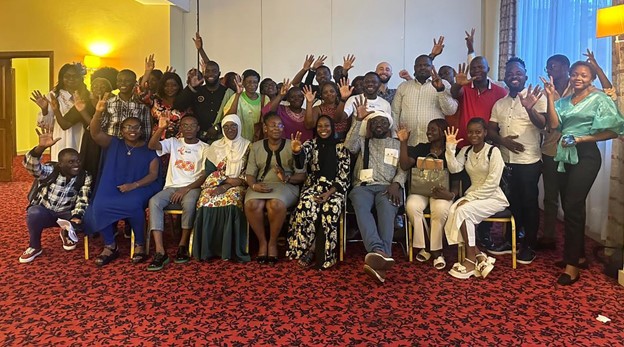
Participants in the RISE workshop held at AFRAVIH in
Yaoundé
(April 2024).
The final report from the RISE study was launched during a side event at the Global Fund’s 51st Board Meeting in Geneva in April 2024. The event featured the co-sponsorship and participation of several Board delegations: Canada/Switzerland/Australia, Communities, Developing Country NGOs, France, Germany, Private Foundations, Southern and Eastern Africa, United States, and West and Central Africa. Additionally, representatives from the CCM Hub and the Community, Rights and Gender department participated. Panelists during the event validated the findings from the study, highlighted their own experiences as former CCM representatives, and affirmed their support for strengthening CCM functioning. Board members described the CCM as the “only structure that gives an equal voice to everyone,” shared personal experiences of being intimidated in their homes while serving as CCM representatives, and called the CCM “the center of gravity of the Global Fund model.”
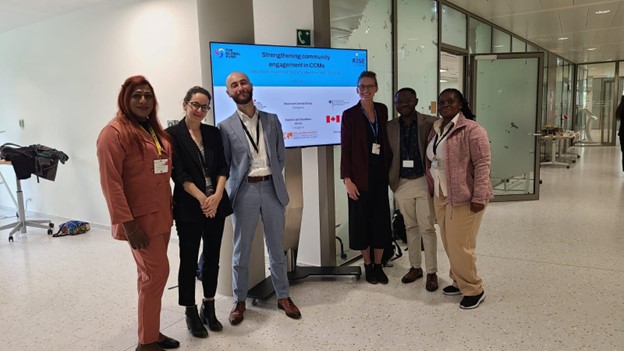
Members of the RISE Steering Committee at the Global Fund Board Meeting (April 2024).
Left to right: Anushiya Karunanithy (Malaysian AIDS Council), Alana Sharp (O’Neill Institute for National and Global Health Law), Léo Deniau (Aides), Jennifer Sherwood (amfAR), Serge Douomong Yotta (Coalition Plus), Sibongile Tshabalala (Treatment Action Campaign).
Recommendations from the RISE Study
The RISE report included seven recommendations for strengthening community engagement in CCMs, which were developed by the RISE steering committee:
- Strengthen Secretariat-led initiatives to inform CCM representatives and other Global Fund partners about CCM policies and guidelines.
- Increase support for community engagement throughout the three-year cycle.
- Implement data-sharing mechanisms that ensure on-time, accessible, and translated information about grant performance and financing.
- Build funding streams that support peer-to-peer mentoring of community CCM representatives.
- Implement reporting mechanisms that ensure sufficient and transparent funding streams for community participation in Global Fund mechanisms.
- Implement a cross-country learning forum for community CCM representatives.
- Strengthen accountability mechanisms for reporting misconduct, abuse; strengthen whistleblowing and expand outreach.
The RISE group is now developing a roadmap for implementing the study recommendations.
Implementation Roadmap
- Disseminate information
- Align funding strategy
- Remove barriers in grant oversight
- Increase regional and global fora for exchange between CCMs
- Create an independent community escalation mechanism
Conclusion
Successfully achieving these goals will require significant effort, coordination, and partnership from across the Global Fund partnership. As the RISE group, we believe our work is just beginning.
[1] The RISE study was an independent research study primarily funded by the organizations in the Steering Committee, which was supplemented by the generous support of L’Initiative.
Tags:
Leave a Comment
Comments
No comments yet. Be the first to comment!