Looking ahead to the Global Fund Strategy in Grant Cycle 7 Part II
Mutually reinforcing contributory and evolving objectives: CRG, RSSH and C19RM/PPR
ABSTRACT
This second article on Looking ahead to Grant Cycle 7 – Strategy examines the Strategy’s “Mutually reinforcing contributory and evolving objectives” from the viewpoint of: Community, Rights and Gender; resilient and sustainable systems for health; pandemic preparedness and the COVID-19 Response Mechanism; and Health Financing. It explores the nuances of Grant Cycle 7 and its future implications, the call for collective efforts and the challenges ahead.
Introduction
As our first article in this series noted, the Board paper on Strategy Implementation: Acceleration into Grant Cycle 7, discussed at November Board meeting, looks at how elements of the Global Fund’s Strategy 2023-2028 have been addressed through funding requests (FRs) submitted in the first three Windows of Grant Cycle 7 (GC7). In that article we covered the three diseases; in this we look at Communities, Equity, Human Rights and Gender (CEHRG); resilient and sustainable systems for health (RSSH); pandemic preparedness (PP) and the COVID-19 Response Mechanism (C19RM). The third article in the series will look at Health Financing and NextGen Market Shaping.
Community, Human Rights and Gender
Despite challenging contexts, programs to address human rights and gender (HRG) barriers, address inequities, and strengthen communities help increase impact of grants
Unfortunately, well-resourced and coordinated global anti-rights and anti-gender movements are making significant progress in eroding the rights of LGBTQ communities, women and girls, and other key and vulnerable populations (KVPs). In all regions, key populations (KPs) and organizations that work with them are facing increasingly hostile political rhetoric, crackdowns on their activities, and restrictions on civic space that are putting them and their work at risk.
However, programs to address HRG-related barriers, increase equity and strengthen the leadership and engagement of communities build a strong foundation that enables communities and their organizations to adapt when risks increase or crises occur. These evidence-based programs reinforce the impact of Global Fund grants and improve disease outcomes.
Progress in key performance indicators (KPIs) shows improvement but highlights the need for continued efforts in domestic financing and addressing human rights barriers
as Figure 2 shows:
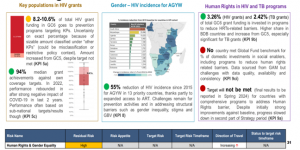
In Windows 1 and 2, the Technical Review Panel noted a rise in FRs addressing gender-related obstacles
This was evident in more than 80% of FRs, including interventions aimed at promoting equity and community wellbeing. Nevertheless, expanding high-quality programs continues to be a hurdle.
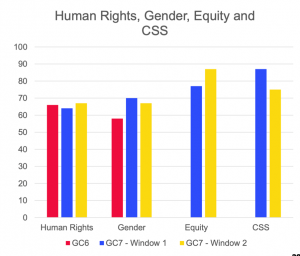
In GC7 FR , requests to address human rights-related barriers plateaued at 66% of grants compared to GC6. Requests addressing gender-related barriers increased from 58% in GC6 to 70% in GC7. An average of 82% of FRs included equity-oriented outcomes. Countries that received Matching Funds and technical support through the Breaking Down Barriers Initiative had higher quality interventions to address HRG- related barriers. An average of 81% included well-defined roles for community-led and -based organizations in service delivery. Integrating quality programs at scale, across the portfolio remains a challenge, particularly in the face of increasing attacks on HRG equality; an increased focus on intersectional approaches is needed.
Figure 2: Human Rights, Gender, Equity and Community System Strengthening across GC6 and GC7
Responding to risks in the current political climate
The Global Fund is adopting a more ambitious and systematic approach in GC7, characterized by key partnerships, requirements such as the Gender Equality Marker, and new definitions and guidance to support the assessment of HRG equality risks in country, program and grant contexts, to identify appropriate mitigation strategies. It is implementing the community, rights and gender (CRG)- related Strategic Initiatives (SIs), including supporting safety and security assessments of KP implementers. Providing technical assistance (TA) to strengthen community engagement and leadership will also mitigate some of the risks in highly volatile contexts. Training on HRG and CSS risks has been held within the Secretariat.
In GC7, the global operational environment has become more challenging, necessitating collective action
As part of its commitment to the Strategy, the Global Fund will:
Scale
up programs and initiatives and expand coverage in more countries to improve the safety and security of KP programs, strengthen community-led monitoring (CLM), and address HRG-related barriers
Innovate
and implement new ideas and initiatives to reach populations left behind, such as work to reach last-mile TB KPs, and get funding to women, girls and gender-diverse communities through the Gender Equality Fund.
Prioritize
new approaches to increasing equity-oriented programming and intersectional approaches.
Strengthen
capacity across the partnership to respond consistently, clearly, and effectively to crises, in a way that does no harm to communities.
Continue
to strengthen Secretariat's approach to equity and intersectionality.
Resilient and Sustainable Systems for Health
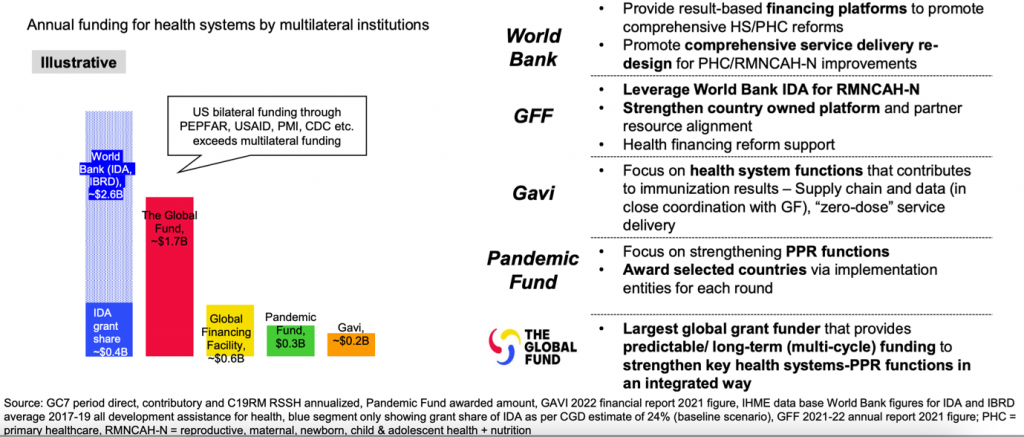
The Global Fund plays a crucial role in global health systems and pandemic preparedness and response (PPR), being the largest multilateral grant financier. Its focus on key systems functions complements collaborative efforts with prominent organizations such as Gavi, the Global Financing Facility (GFF), the Pandemic Fund and the World Bank, aiming for comprehensive health system reforms and effective PP.
Figure 3. Multilateral institution annual funding for PPR
The Global Fund's RSSH-PPR programs aim to leverage its unique strengths, characterized by six distinct attributes:
- Effectively collaborates with governments, the private sector, and communities, offering integrated people-centered services, unlike approaches solely through governments, non-government organizations (NGOs), or other entities.
- Integrates investments in combating HTM with initiatives to develop health systems and PPR capacity, utilizing platforms such as data systems and surveillance, infrastructure like labs and supply chains, and human resources.
- Enhances broader health system capacity by simultaneously reducing disease burden and investing in health system capabilities and infrastructure.
- Strengthens countries' key RSSH-PPR functions through predictable and long-term (multi-cycle) funding, as opposed to sporadic or opportunistic support.
- Combines market shaping with support for local manufacturing, strengthening supply chains and service delivery systems, providing end-to-end support rather than focusing solely on service delivery support.
- Works in partnerships with set-asides, HTM situation rooms, RSSH-PPR working groups, and regional institutions (e.g., Africa CDC) through SIs and Centrally Managed Limited Investments (CMLIs), rather than pursuing isolated projects.
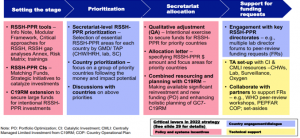
In preparing for GC7, the Secretariat delivered all planned activities to improve the quality and quantity of RSSH-PPR FRs
Figure 4. Supporting the development of robust RSSH-PPR interventions in FRs
Preparation also included identifying drivers of low absorption in GC6 for mitigation in GC7
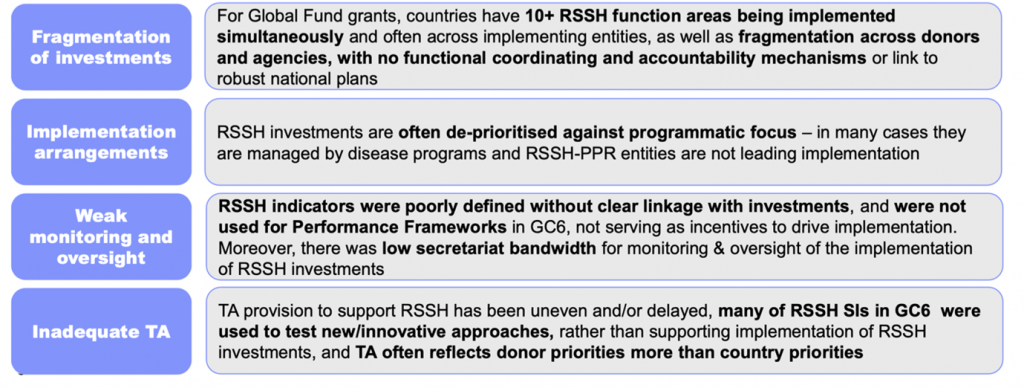
The COVID-19 context in GC6 made RSSH investment implementation somewhat challenging as grants were delayed, ministries had other urgent priorities and TA could not be effectively deployed. However, there are underlying structural factors propelling low RSSH implementation that should be tackled for GC7.
Figure 5. Structural issues affecting RSSH implementation
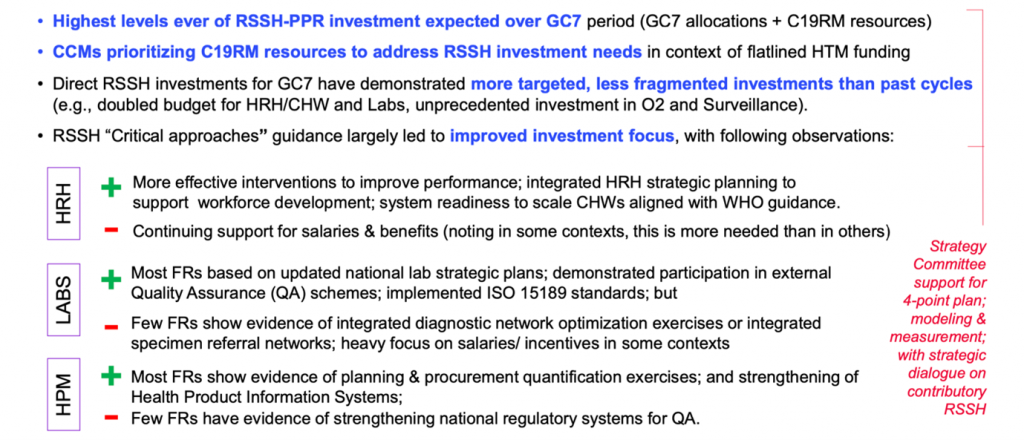
Preliminary GC7 observations show promise in prioritization and focus, with work remaining
Figure 6. Early signs of RSSH-PPR improvement in GC7
Second Portfolio Optimization (PO) of C19RM resources is driving a deliberate shift towards RSSH and PPR
Strategic shift is evident
.
78% of the C19RM reinvestments and PO Wave 2 Awards (as of 6 October) reflect the shift to RSSH and PPR, with strong, fit-for-purpose country consultation demonstrated.
Strong country examples to build on
.
Good examples of innovative, effective country governance and implementation arrangements, e.g., Zambia Ministry of Health (MOH) Principal Recipient (PR) delegated lead convening authority and implementation oversight responsibilities to the Zambia National Public Health Institute (NPHI)
Improved Performance Frameworks
including custom Workplan Tracking Measures to guide programming.
Alignment with the World Bank Pandemic Fund (PF)
✓ The Global Fund is not a recipient of PF funds from its first call for proposals; efforts are underway to ensure complementarity of investments (the PF first call focused on three of the same investment areas as PO Wave 2).
✓ Leveraging Country Coordinating Mechanisms (CCMs) and MOHs (as PR for many C19RM grants and PF proposal leads) to strengthen alignment between investments at country level and enhance community and civil society engagement.
✓ The Global Fund is actively engaging with the PF to strengthen collaboration going forward; awaiting lessons learned and next steps from the PF.
Looking ahead: Ensuring increased alignment, prioritization and partnerships for GC7 and C19RM
- There is a need to implement differently, addressing key bottlenecks, to achieve and demonstrate results from doubled direct RSSH-PPR investments.
- Some CCMs require more systematic and sustained engagement with public sector health system and related governance bodies to ensure robust planning and coordination of investments mapped to national strategies.
- Further support is required for RSSH-PPR prioritization and integration across funding sources.
- However, efficient approaches to systems strengthening are a structural challenge facing all funders (domestic, bilateral, multilateral), with no best-case model to follow.
Actions for Secretariat and Partnership
Secretariat:
- Bold prioritization with intensified implementation support and full set of indicators in select countries where RSSH-PPR invests.
- Targeted expansion of RSSH-PPR TA through CMLI, as well as coordination with partner TA set asides.
- Focused engagement and tracking to improve implementation arrangements (e.g., NPHIs, lab, Community Health and Human Resources Directorates); investments in national plans; national coordination mechanisms)
- Strengthening CCM visibility of and alignment with national health governance platforms (RSSH, PPR) via CCM Evolution and beyond.
- Grant management action requiring workplan-level coordination between Global Fund and PF investments to be closely tracked to maximize synergies.
- Global Fund-Gavi: a workstream was launched on enhancing coordination on RSSH investments as part of wider collaboration between the two institutions.
Larger partnership considerations:
The Fund welcomes suggestions for strengthening RSSH-PPR implementation for GC7 and C19RM, and on how to best position the Global Fund going into the Eighth Replenishment.
Stakeholders’ feedback
Looking ahead to GC7 implementation, stakeholders highlighted the significance of SIs and Matching Funds in advancing CRG and CLM. Concerns about reduced investments and the impact of lower funding on CRG were raised by some of the stakeholders who also called for increased multi-country funding to address stigma and discrimination, especially in cross-border initiatives benefiting displaced persons.
People emphasized the need for a holistic approach, strong leadership at the country level, and coordination among partners to achieve set objectives, cautioning against assuming the inherent readiness of CCMs. They proposed accelerating efforts to get HTM achievements back on track while documenting cross-cutting benefits with factors like RSSH, PPR, reducing health inequities, and climate change.
Stakeholders emphasized the importance of reviewing country commitments to UN meetings on TB, Universal Health Coverage (UHC), and pandemic preparedness. They acknowledged progress in returning to essential health services after COVID-19 but expressed concerns about emerging challenges such as wars, climate change, and threats to human rights. Some acknowledged that the shift towards RSSH/PPR is crucial and recommended mid-term reviews.
Many commended efforts to address COVID-19 challenges and were worried about funding gaps post-Seventh Replenishment. They raised questions about the discontinuing funding for regional Green Light Committees and called attention to underperforming KPIs. They continued to advocate for ongoing investment in harm reduction, pre-exposure prophylaxis (PrEP) uptake, and equitable access. Finally, they stressed the importance of community and civil society participation, disaggregated data, and a review of the Global Fund Sustainability, Transition and Co-financing Policy in 2024.
******
Board paper GF/B50/08 Strategy Implementation: Acceleration into Grant Cycle 7 will soon be available on the Global Fund website.Tags:
Leave a Comment
Comments
No comments yet. Be the first to comment!