Office of the Inspector General Operational Progress Report 2023
N/A
ABSTRACT
The Office of the Inspector General submitted its Operational Progress for the period January to August 2023 to the Global Fund Board for review during the Board’s 50th meeting held 14-16 November 2023. The report provides a comprehensive picture of the work that the OIG has been doing and its workplans for the year ahead. This article summarises the report and reactions of some of the stakeholders.
Introduction
The Global Fund Board meeting this week discussed a report submitted by the Office of the Inspector General (OIG), Operational Progress Report on the period January-August 2023.
The report begins by informing the Board that OIG’s work in the first eight months of 2023 has identified four themes that require the attention of the Board, the Audit and Finance Committee (AFC) and the Secretariat:
- Despite persistent challenges, HIV and TB results have generally improved; but malaria remains off track.
- Ongoing challenges in implementing longer term investments could constrain the Global Fund’s effectiveness.
- Supply chain risks remain high but sustained investments have led to positive results in some countries.
- Risk trade-offs need to be better articulated and adapted to the changing global health landscape.
It then goes on to provide the operational update and outlook for 2024.
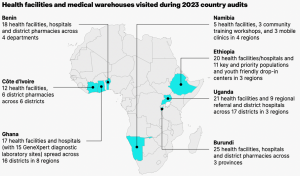
Throughout the second section of the report, reference is made to the OIG audits in Burundi, Côte d’Ivoire, Ghana, Namibia and Uganda. However, to date, only the audit reports for Burundi and Namibia have been completed and published; and there is no mention of the audits in Benin and Ethiopia which are shown later in Figure 2 below.
Emerging themes from OIG work in 2023
Sustained progress for HIV/TB but malaria remains off track
OIG’s engagements show significant progress has been made in the fight against the three diseases and recovery of many of the gains that had been lost to COVID-19. While HIV and TB results have generally improved, some challenges in interventions targeting key and vulnerable populations (KVPs) remain. The report notes that services to key populations (KPs) are critical for ending the epidemics. However, rising legal barriers, cultural practices and suboptimal implementation could delay efforts to reach these groups. For instance, legal barriers affecting services to certain populations contribute to delayed implementation of activities. Cultural practices continue to affect hospital attendance by pregnant women, affecting interventions for preventing mother-to-child transmission, contributing to disproportionately high HIV infections among children.
Malaria programs across multiple countries are off track with, except for Ghana, an increase in incidence and deaths. This means that the overall objectives of malaria grants across many countries are unlikely to be achieved in the short term.
Ongoing challenges
The Global Fund’s Strategy recognizes the importance of building Resilient and Sustainable Systems for Health (RSSH) with significant resources invested in such interventions, which are crucial for achieving the Global Fund’s mission. However, the Global Fund’s model – including Secretariat processes and typical in-country grant implementers – is primarily oriented to execute disease programs rather than health system strengthening activities. OIG suggests that the Global Fund’s approach to disease programs needs to be adapted if it is to overcome the challenges inherent in implementing longer term activities such as health system strengthening.
Supply chain risks
Material supply chain risks remain in several portfolios and the overall risk is expected to remain high over time. Some challenges remain in addressing stock-outs in health facilities (HFs) and there have been cases of countries not honouring co-financing commitments which has affected the availability of medicines.
Risk trade-offs
The global health landscape is changing rapidly. The Global Fund therefore needs to adapt and evolve to respond to those changes. A key part of this is the need to better articulate the risk trade-offs necessary for staying on track in the fight against HIV/AIDS, TB and malaria and building RSSH. This will require a more active approach to risk taking, better and sustained use of innovation and a streamlining of processes at both the Secretariat and country levels.
OIG Operational Update
Figure 1 shows the OIG audit and advisory workplan as of 31 August 2023:
Figure 1. 2023 Audit and Advisory
workplace at a glance as of 31 August 2023
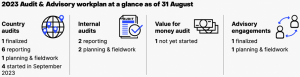
OIG published ten audits in January-August 2023 and completed three advisories. Twelve engagements are ongoing, with at least eight expected to be published by the end of 2023.
OIG staff visit central and regional medical stores, HFs and other service delivery areas to verify first-hand how Global Fund-supported programs are implemented. So far this year OIG teams have visited more than 97 HFs during in-country missions (see the full list in Figure 2).
Figure 2. Health facilities and medical w
arehouses visited during 2023 country audits
Planning for 2024-2026
The 2024-26 workplan draws heavily from the previous three-year workplan, and reflects recent changes in the risk landscape, organizational priorities and processes, security considerations and the work of other assurance providers, such as the External Auditor. Figure 3 provides a snapshot of OIG’s audit and advisory workplan for 2024.
Figure 3. 2024 Audit and Advisory workplan snapshot
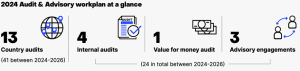
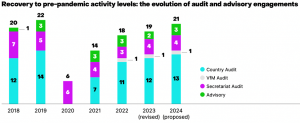
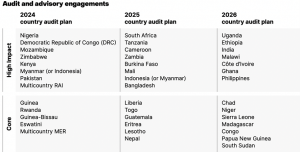
The 2024 audit and advisory workplan continues to place a significant focus on country-level assurance, with 13 country audits, bringing OIG’s delivery back to pre-pandemic levels as shown in Figure 4.
Figure 4. Recovery to pre-pandemic activity levels: the evolution of Audit and Advisory engagements
Country audits
Aligned with its risk-based methodology, OIG anticipates conducting audits in all high-impact countries at least once within a three-year cycle, while most high-risk core countries will undergo audits every five years. The planned audit and advisory engagements are listed below.
Figure 5. Audit and Advisory engagements
Internal audits
In 2024 OIG will audit the following areas:
- Health products quality assurance.
- Risk management.
- Human resources management processes.
- Process of the Evaluation and Learning Office.
Professional Services Unit (PSU)
In 2023, the PSU has continued to improve the OIG’s analytics and insights capabilities, evaluated the alignment of processes and systems, screened complaints for appropriate OIG response and provided operational support.
OIG has continued to experience a notable increase in the volume of complaints received, with a total of 287, marking a 12% increase on the same period last year, and 69% increase on 2021 – see Figure 6.
Figure 6. Total complaints received (2o20-2022 versus 2023 to date)
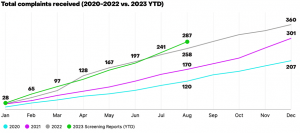
The increase in complaints, as well as the merging of the screening and assessment phases, has contributed to delays in achieving OIG’s 30-day target for screening allegations, as of August 2023 (actual: 36 days). However, this process has led to a more targeted approach to investigations, ensuring best use of investigator resources.
In 2023 PSU further expanded OIG’s pilot Text Analytics program to encompass a larger and more diverse collection of documents and countries. PSU also actively explored ‘speech- to-text’ models, tailored to OIG’s context, for the purpose of transcribing the content of audio recordings into text. This will allow teams to efficiently transcribe, translate, and summarize conversations, emphasizing the identification of key topics.
The PSU team continues to provide operational support to facilitate the delivery of the OIG workplan including recruitment of technical consultants, quality assurance activities, and active monitoring of Agreed Management Actions.
In 2024 PSU will continue its work to provide support to delivery teams, including quality assurance reviews, timely response to allegations, furthering the implementation of OIG’s advanced analytics, and to build additional partnerships with other oversight functions.
Investigations
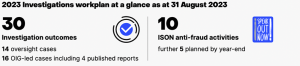
Figure 7 shows the Investigations Unit workplan for 2023:
Figure 7. 2023 Investigations Unit workplan
Cases opened
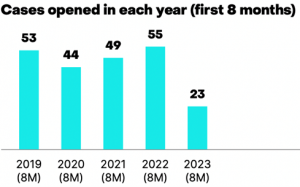
With a greater emphasis on thorough assessment at the complaint receipt stage, there has been a substantial reduction in the number of cases opened in 2023. As of August 2023, 23 new cases had been opened compared to 55 cases at the same time in 2022 – see Figure 8. The 42% decline is a direct result of the revamped case intake process, allowing OIG investigators to concentrate their efforts on the most material and impactful cases.
Figure 8. Cases opened in first 8 months of each year
Using the same focus on risk and impact, the number of active cases is decreasing, with 76 active cases as of August 2023 (40 oversight cases and 36 OIG-led cases), in comparison to 86 at the beginning of the year. The reduced number of complaints converted to cases will also allow the Investigations Unit to explore more proactive approaches to integrity risk management.
Cases closed and published
As of August 2023, the Investigations Unit had closed a total of 30 cases, comprising 14 oversight cases and 16 OIG-led cases.
OIG has published four investigation reports, against the year-end target of five reports. These cases contributed to refocusing the Global Fund’s response to sexual exploitation, abuse and harassment risks at country level. Two more reports are anticipated to be finalized and published by the end of the year.
Through case closures up to August 2023, OIG proposed the recovery of $130,132 as well as suggested lessons learned.
Fraud awareness and outreach activities
OIG conducted ten awareness-raising activities, of which six were related to sexual exploitation and abuse and the remaining four on other types of Global Fund prohibited practices.
Investigation workplan
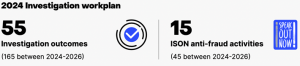
The 2024 workplan – see Figure 9 – will focus on investigations that are more likely to identify systemic integrity risks, lessons learned, and where appropriate, recoveries:
- 22 new OIG-led investigation cases and 18 oversight cases are projected, based on historic volumes, conversion rates, and the number of cases initiated in 2023.
- OIG anticipates completing 55 investigations in 2024, with an average case completion time of one year.
- By engaging with the front-line and second-line functions, the Investigations Unit will streamline fraud prevention activities.
- OIG is developing a methodology to proactively identify integrity risks indicative of potential prohibited practices as a supplement to the allegations received.
- OIG will organize a total of 15 awareness-raising events targeting Secretariat staff, implementers, and in-country assurance providers.
Figure 9. 2024 Investigations workplan
Stakeholder feedback
Stakeholders applauded the OIG for a very comprehensive operational progress report and welcomed the solid progress in delivering the 2023 work plan; as well as concurring with the proposed three-year work plan.
However, while people were encouraged to see progress on HIV and TB programs from countries that were audited, they remain worried by malaria programs that are off track. Despite concerted efforts through various strategies such as increased coverage and treatment, and significant deployment of both bed nets and indoor residual spray, data from the audited countries show a surge in malaria incidences. People were especially concerned for the Africa region which bears over 96% of the malaria burden in terms of both morbidity and mortality, and felt that more needs to be done in this region to ensure the population at risk is protected.
Regarding ensuring the quality of health products, many stakeholders noted that they had been advocating the need for this in the fight against malaria and other diseases. Quality medicines are central to the goal of achieving Universal Health Coverage and with less than seven years remaining towards the Sustainable Development Goal (SDG) target year of 2030, the audited results are depressing. They called upon the partnership to remain committed to ensuring that the medicines are of quality, available, affordable, and accessible by all communities who need them.
Stakeholders underscored the importance of the OIG calling attention to the persistent challenges in implementing longer term investments, as corroborated by the Financial Performance pre-read. Moreover, they said, Program Management Units, Principal Recipients, Country Coordinating Mechanisms and Country Teams need to develop and foster collaboration with a broader set of departments in ministries of health. This could provide entry points for positioning HTM programs and CCMs in the wider health system context.
******
The Board papers GF/B50/07, the Office of the Inspector General Operational Progress Report January to August 2023, and GF/B50/21, Agreed Management Actions Progress Report, will soon be available on the Global Fund website.
Tags:
Leave a Comment
Comments
No comments yet. Be the first to comment!