Global Fund's Strategy Committee discusses the detrimental effects of the climate crisis on the fight against disease
N/A
ABSTRACT
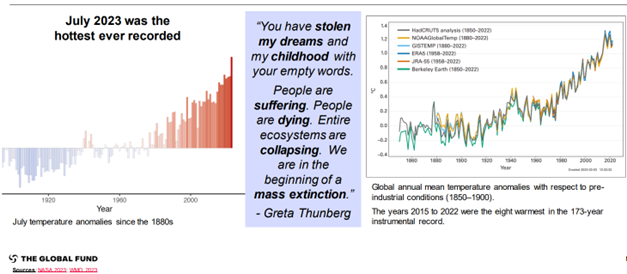
Figure 1. Global overview of the climate emergency
Source: Global Fund
The general implications of the climate crisis The climate emergency is a major concern because it jeopardizes life on Earth, including our health, our food security, our wellbeing and that of future generations.- Record levels of flood-related displacement were observed in Nigeria and Pakistan in 2022.
- The longest and most severe drought on record has displaced two million people in Ethiopia, Kenya and Somalia,
- Global warming affects weather conditions, the ability to produce food and, by extension, food prices.
- In 2021, 2.3 billion people were facing insecurity and nearly 10% of the world's population was undernourished.
- Since 2020, the Great Horn of Africa has been affected by the longest drought in 40 years. According to estimates, 37 million people are facing acute food insecurity in the region.
- Food productivity growth is down 21% due to global warming.
- The economic effects of climate change are significant. Even in a high-income country like the USA, we can expect a loss of income of $2,000 billion a year by 2100.
- Climate-induced migration could affect 86 million people in Africa, 89 million in Asia and 17 million in Latin America by 2050.
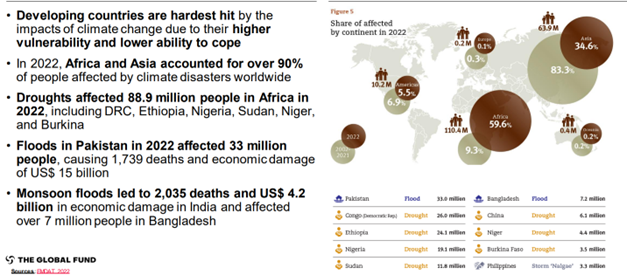
Figure 2. Impact of climate disasters disproportionately affecting developing countries with high disease burden, weak health systems and fragile and conflict contexts
Source: Global Fund
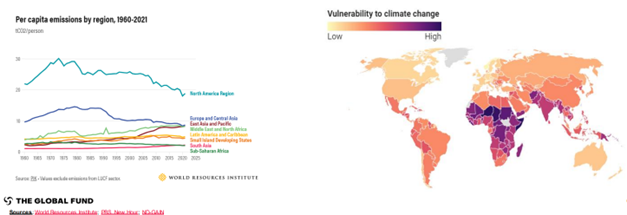
The Secretariat’s report to the Strategy Committee also shows that we are not indiscriminately responsible for the climate crisis. Communities, who contribute the least to climate change, are the ones who suffer the most. What's more, the report makes it abundantly clear that social inequalities reinforce health vulnerabilities, prolong pandemics and fuel inequality in the length and quality of life on an international scale.Figure 3. Communities least responsible for climate change are some of the most climate vulnerable
Source: Global Fund
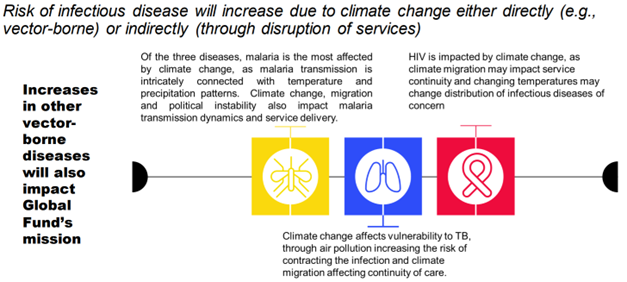
The impact of the climate crisis on health in general and the fight against HTM in particular If nothing is done, climate change risks not only reversing progress in global public health but also paving the way for the emergence or re-emergence of infectious diseases with dramatic and unexpected consequences. What we can already see, says the Report under review - and more recently, the Global Fund 2023 Results Report reviewed in last week’s GFO (you can read it here) - is that climate change represents a systemic threat to the Global Fund's mission.Figure 4. Climate change and HIV, TB and malaria
Source: Global Fund
The alarming observation made by the Secretariat in this Report echoes the Global Fund's 3 December 2021 Declaration on Climate Change and Environmental Sustainability. It states: "The risks posed by climate change and environmental contamination to HIV, TB and malaria programs and to the underlying health and community systems that support and deliver services to communities are real. Climate change will further exacerbate extreme weather events, forced displacement, decreased air quality and increased food, water and economic insecurity, all of which have a negative impact on health. Changes in rainfall, temperature and humidity may shift malaria transmission to areas that may not be adequately resourced or prepared to prevent, detect, and treat malaria. Climate change will also impact tuberculosis and HIV, likely through a complex array of factors that will disproportionately affect the most vulnerable. Forced displacement or migration due to climate change can disrupt diagnosis and treatment services, and economic insecurity caused by climate change can create conducive environments for increased transmission rates and increase people's vulnerability to disease. Air pollution - both indoor and outdoor - is estimated to kill approximately seven million people per year and plays a significant role in causing respiratory illnesses.2 Poor air quality and overcrowding due to forced migration may contribute to the transmission of respiratory diseases such as tuberculosis and COVID 19 ". The Global Fund's response to the climate crisis As part of its new Strategy 2023-2028, the Global Fund and its partners have identified the issue of climate change as one of the key challenges to achieving its mission. The Strategy explicitly mentions that "climate change risks losing ground gained on the three diseases and rolling back health in general". (Strategy 2023-2028, p. 57).Figure 5. Global Fund Strategy2023-2028 on climate change
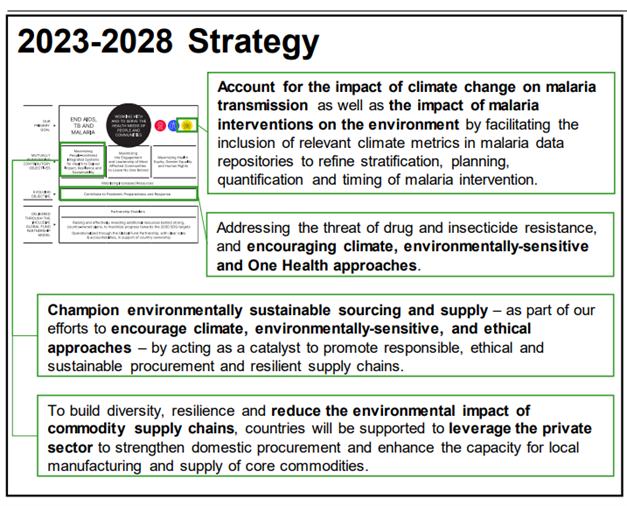 Recognizing the impact of climate change on the burden of disease, the Global Fund has begun to integrate climate change into its internal operations and funding mechanisms. As the report points out: "Addressing climate change is not an expansion of the Global Fund's mission, but a response to an unprecedented shift in the context of human life on earth that will affect most aspects of the Global Fund's work. As such, it is best understood as a critical context and lens through which we view all our work".
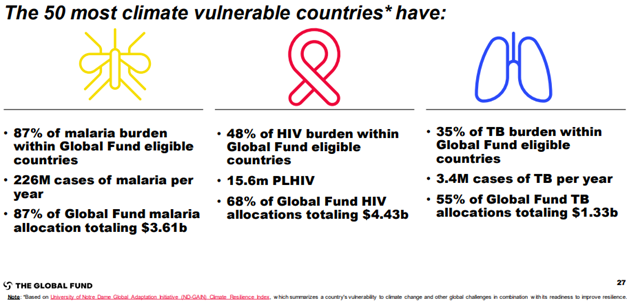
What's more, the report underlines, with figures to back it up, that the Global Fund devotes the bulk of its grants ($ 9.3 billion or 71% of Grant Cycle 7) to the countries most exposed and vulnerable to climate change, which, for the most part at least, also have a high burden of HTM.
Recognizing the impact of climate change on the burden of disease, the Global Fund has begun to integrate climate change into its internal operations and funding mechanisms. As the report points out: "Addressing climate change is not an expansion of the Global Fund's mission, but a response to an unprecedented shift in the context of human life on earth that will affect most aspects of the Global Fund's work. As such, it is best understood as a critical context and lens through which we view all our work".
What's more, the report underlines, with figures to back it up, that the Global Fund devotes the bulk of its grants ($ 9.3 billion or 71% of Grant Cycle 7) to the countries most exposed and vulnerable to climate change, which, for the most part at least, also have a high burden of HTM.
Figure 6. Global Fund supports countries with both high HTM burdens and high climate vulnerability
Source: Global Fund
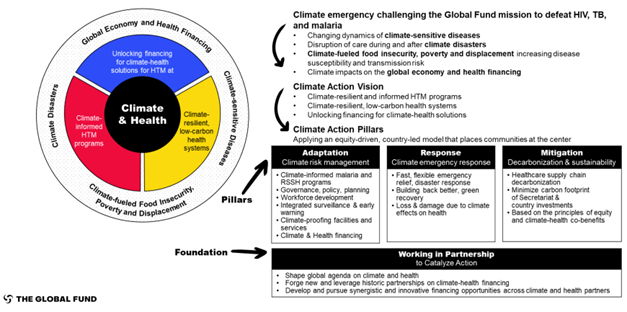
To combat the health risks posed by climate change, the Global Fund is increasingly studying and investing in smart health interventions. It helps countries build their capacity to respond to the health impact of climate change, while strengthening global efforts to combat disease. This includes strengthening surveillance systems to detect epidemics influenced by climate change, promoting resilient healthcare systems, and supporting innovative approaches to improve disease prevention and control in the face of climate variability. In concrete terms,- The Global Fund's grant agreements with recipient countries support national responses that consider the impact of climate change on diseases, as well as the environmental impact of disease control activities. The processes of applying for funding and engaging in dialogue with countries also enable them to design and prioritize investments that strengthen and build climate-resilient health systems so that they are better able to cope with the impacts of potential climate-related disasters.
- Grant flexibilities and the Emergency Fund are the Global Fund's first line of support for countries facing climate-related disasters such as cyclones, floods and drought.
- Catalytic investments such as the Digital Health Impact Accelerator Matching Fund integrate climate resilience as a key priority to further help countries sustain health progress in the context of a changing climate.
- The Global Fund supports the transition to low-carbon healthcare systems through clean energy, waste management and supply chain efficiency.
Figure 7. A climate action framework seeks to protect HTM and RSSH gains in the context of an escalating climate emergency
Source: Global Fund
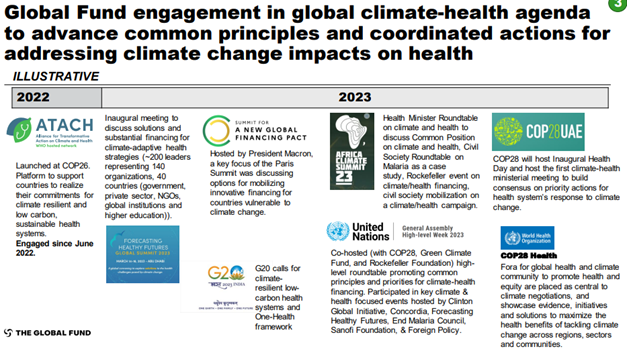
More broadly, the report emphasizes that the Global Fund's merges with that of other partners. For the challenge posed by the climate crisis necessarily calls for synergies of action, and a pooling of strengths and interventions. As such, the Global Fund's work is aligned with several of the United Nations' Sustainable Development Goals (SDGs), notably SDG 3: good health and wellbeing, and SDG 13: climate action. Simply put, the Global Fund's efforts in disease control contribute to the health-related goals of the SDGs, while its growing recognition of the links between climate change and health testifies to its commitment to climate action.Figure 8. Global Fund engagement in the world’s climate-health agenda
Source: Global Fund
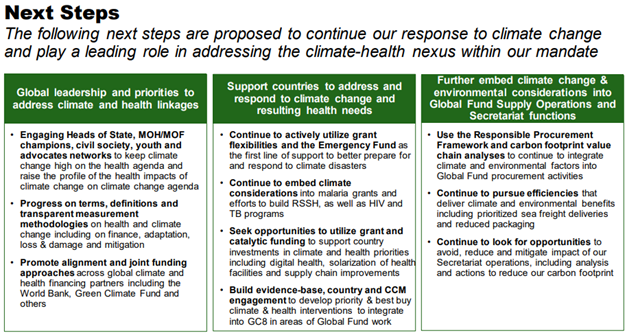
These are critical times, when bold decisions and immediate action are needed to mitigate the effects of climate change and ensure sustainable health for all. In this regard, the Secretariat has spelled out a series of upcoming Global Fund actions.Figure 9. Proposed next steps for the Global Fund’s climate-health agenda
Source: Global Fund
Comments from stakeholders In general, the majority of stakeholders say they are reassured to see the extent to which the Global Fund is already engaged in the fight against climate change, and the adaptation, response and mitigation measures that are being pursued and promoted, as well as the plans that are moving forward. However, they also expressed a number of concerns. Most significantly, they are alarmed by the significant funding gap of $1 billion per year for malaria, and they have called for discussions on resource mobilization strategies. In particular they would like to focus on the expectations and specificities of middle-income countries in terms of disaster risk management, blended financing and debt conversion. More broadly, while the Secretariat cited convincing evidence of the imperative for climate action it does not yet, say stakeholders, outline a way forward that is compatible with the current and anticipated impact of the crisis. They therefore call on the Global Fund to develop a strategy with clear objectives within its mandate to address the link between climate and health. They also asked the Secretariat to assess evidence of the complexity of community-based climate awareness and preparedness initiatives, and to share lessons learned from climate displacement and refugee health programs to inform the Global Fund partnership as a whole. Finally, stakeholders asked a number of questions that they want the Secretariat to answer: How will the Global Fund integrate a climate perspective into the work of the Community, Rights and Gender Strategic Initiative, and vice versa? Given the rapid adoption of digital technologies, how does the Digital Health Impact Accelerator plan to address and mitigate the negative impacts of e-waste? With regard to Global Fund actions to promote climate resilience, will this integration take place as part of grant applications or through a parallel mechanism? How will it be financed, and what measures are in place to ensure accountability, robust reporting and effective data collection? Finally, stakeholders recognize that mainstreaming the climate issue represents an additional task for already busy national teams. With this in mind, they note that there is no mention of training for these teams, or of their role (or that of other staff) in relation to climate change interventions supported by the Global Fund.Tags:
Leave a Comment
Comments
No comments yet. Be the first to comment!