MOPAN assessment of UNAIDS Secretariat
A tough but fair appraisal says the Joint Programme needs a rethink
ABSTRACT
The Joint United Nations Programme on HIV and AIDS (UNAIDS) is a key partner of the Global Fund. The findings of the recently published report by the Multilateral Organisation Performance Assessment Network (MOPAN) on its assessment of the UNAIDS Secretariat is therefore of importance to those in the Global Fund who interact with the UNAIDS. The report is detailed and hard-hitting. This article summarises the main findings and the assessment’s view of the way forward to ensure that the Joint Programme stays on track to fulfil its objectives. The UNAIDS Secretariat will have to change some of its working practices especially with regard to its relations with Cosponsors; and Cosponsors will have to collaborate better with – and assist – the Secretariat to make those changes.
Background
In August 2023, the Multilateral Organisation Performance Assessment Network (MOPAN) published its fourth assessment of the Joint United Nations Programme on HIV and AIDS (UNAIDS) Secretariat.
The MOPAN Secretariat and the assessment team developed a methodology with a twin purpose:
- To assess how well the UNAIDS Secretariat has responded to the five areas of improvement suggested in the MOPAN 2015-16 assessment.
- To consider the degree to which the UNAIDS Secretariat is fit for purpose from the point of adoption of the Global AIDS Strategy 2021-2026 (GAS) onwards, based on its five agreed functions: (i) leadership, advocacy and communication; (ii) partnerships, mobilisation and innovation; (iii) strategic information; (iv) co-ordination, convening and country implementation support; and (v) governance and mutual accountability.
The assessment therefore had both backward- and forward-looking components.
To put the assessment findings into context, the report notes the significant changes that have occurred in the Secretariat as well as externally during the period under review.
UNAIDS Secretariat changes
The UNAIDS Secretariat employed 483 professional staff as of 2020: 177 at the headquarters in Geneva or the Global Centre, 70 in regional offices, and roughly half (236) at UNAIDS country offices.
The UNAIDS Secretariat senior leadership changed in 2019, around the time of developing the GAS and the 2022-26 Unified Budget, Results and Accountability Framework (UBRAF). Under the leadership of the new executive director, the UNAIDS Secretariat started an internal transformation, including realignment of the organisation and a culture transformation.
The organisational realignment has five objectives related in part to the Joint Programme and in part to the Secretariat specifically. The objectives are that the UNAIDS Secretariat will be: (1) aligned with the new GAS and to achieve its highest impact; (2) financially sustainable and more cost-effective; (3) diverse and inclusive and therefore legitimate and credible; (4) knowledge-driven and optimising its worldwide expertise and staff; and (5) aligned with UN reform, principally pandemic preparedness. The alignment includes further reducing staffing costs through voluntary separations and the abolition or consolidation of positions. Costs have also been reduced through relocation of some global management services and programmatic support functions to regional hubs in lower-cost locations – including Bangkok, Bonn, Johannesburg and Nairobi – as well as the reprofiling of some positions from international professionals to national professional officers. The report notes that the recent organisational realignment of the Secretariat has raised concerns among staff.
External context
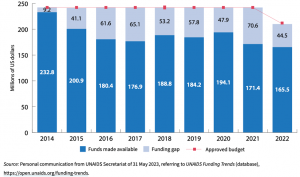
The assessment notes three external factors. First, donor funding to UNAIDS, including through the UBRAF, has continued to decline. Since 2014, the Secretariat and Cosponsors have faced challenges in resource mobilisation for the core UBRAF as well as for non-core additional HIV programme funding. This is largely due to shifting donor priorities towards migration, COVID-19 and more recently the war in Ukraine as well as the improvement in the global HIV situation, with more countries achieving epidemic control. UNAIDS also lost some of its traditional donors and is unable to avoid foreign exchange fluctuations due to short-term donor commitments. Responding to the reality of reduced donor funding, the current (2022-23) UBRAF was scaled down from $242 million to $210 million annually. Despite this adjustment, the UBRAF annual workplans for 2022 and 2023 were still not fully funded. The Secretariat reports core revenue for 2022 of $165.5 million, down from $171 million in 2021 (against the annual target of $210 million).
Second, partnerships with the President’s Emergency Plan for AIDS Relief (PEPFAR) and the Global Fund have become increasingly important.
Third, the COVID-19 pandemic had a profound effect on UNAIDS and the Secretariat and their internal and external context.
Partner survey
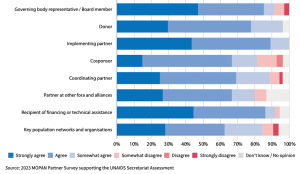
MOPAN undertook a partner survey, the results of which support the Secretariat assessment.
Figure 1: Partner opinions on extent to which UNAIDS strategies respond to/reflect the intended results of normative frameworks for equality and human rights
Assessment findings
The assessment report states that, despite noteworthy strengths and achievements in areas under the Secretariat’s direct control, UNAIDS and its Secretariat are in a worse situation than in 2016.
Modest progress
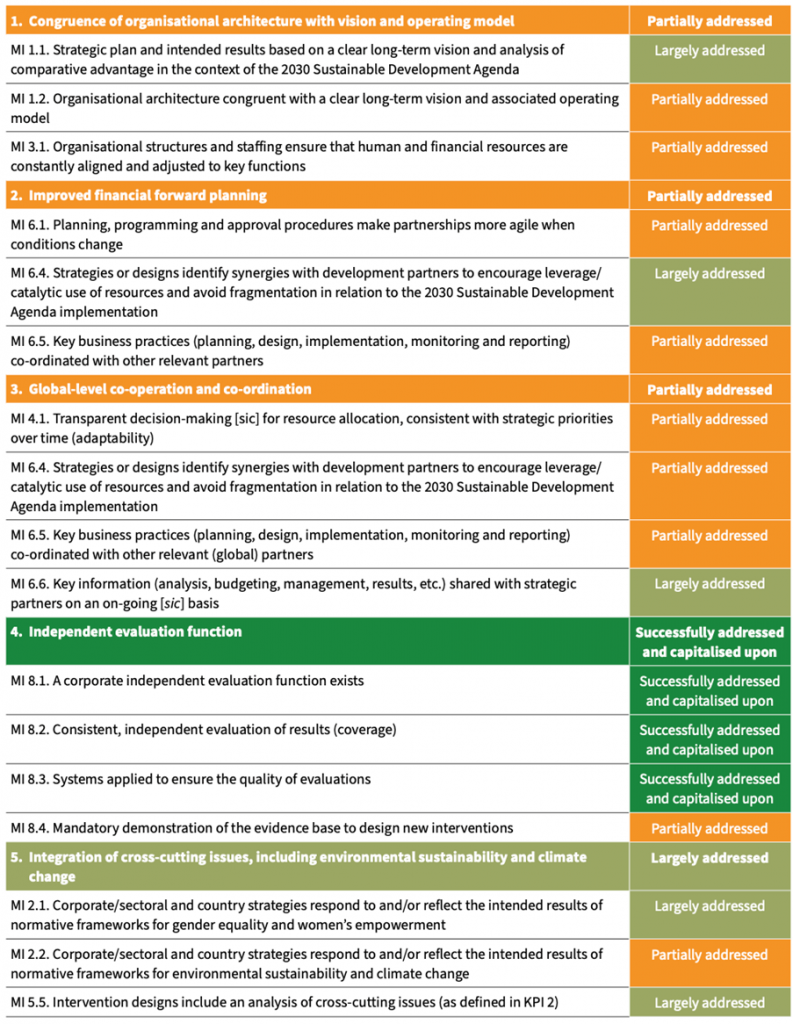
MOPAN found that over the period from 2016 to March 2021 the UNAIDS Secretariat made progress in most of the five areas identified as needing attention by the previous assessment: (i) congruence of organisational architecture with vision and operating model; (ii) financial forward planning and engagement with Cosponsors for joint resource mobilisation; (iii) global co-operation and co-ordination and transparency in decision making at the highest level; (iv) an independent evaluation function; and (v) cross-cutting issues including environment and climate change (see Table 1).
The assessment found that the UNAIDS Secretariat had made limited progress in areas that involved or depended on its external relationships, especially with Cosponsors. Resource constraints limited financial planning despite development of a resource mobilisation strategy in 2017.
Table 1: Progress in Areas Identified for Attention in 2015-16 Assessment
Poor coordination and collaboration
While the revised operational model supported country action, it negatively affected global-level coordination with Cosponsors. This is because the Secretariat is not sufficiently able to coordinate, fund and provide leadership to UNAIDS, including to Cosponsors. Although the Secretariat successfully coordinated the development of a new 2022-26 UBRAF, it struggles to coordinate UNAIDS’ partners in its implementation. Collaboration with Cosponsors at global level is strained; and the UBRAF is only partly funded. Although the Secretariat’s function of providing leadership and global advocacy for the HIV response is undisputed, leadership remains to be defined around a long-term vision for the UN response to HIV after the goal of ‘ending AIDS by 2030’.
Unable to raise sufficient financial resources
The UNAIDS Secretariat has struggled to raise adequate resources and has been unable to fully fund the UBRAF since 2014. Mobilising resources for the biennial UBRAF workplans, jointly with Cosponsors, is one of the Secretariat’s core functions, but this task has become challenging in the current financing climate. The 2022-26 resource mobilisation strategy acknowledges a funding crisis. The ‘core’ UBRAF funds are unearmarked, preferred by the Secretariat and Cosponsors because such resources offer more flexibility than the earmarked funding that they raise individually to complement their UBRAF allocation. The UBRAF budget covers allocations for the Secretariat, Cosponsors, and joint UN teams on AIDS (JUNTA) referred to as ‘country envelopes’. Failure to fully resource the UBRAF has resulted in cuts to all allocations: for example, cuts for each Cosponsor from $3 million to $2 million since 2022 and additional cuts of 30% in 2023 for country envelopes.
Strained relations with some Cosponsors
Of particular significance to the Global Fund, the assessment found that the UNAIDS Secretariat also struggles to satisfy the expectations of Cosponsors, which has led to growing tensions in UNAIDS. The strained relationship between the Secretariat and Cosponsors, especially at global level, jeopardises UNAIDS’ future. One source of tension is the role of the Secretariat in relation to Cosponsors and the Secretariat’s comparatively large workforce and budget. Due to reduced UBRAF allocations, Cosponsors find themselves obliged to rely instead on their corporate HIV resources, which seriously impacts the ability of some Cosponsors to address HIV when there has been a global reduction in HIV financing.
Global advocacy
Another source of tension relates to the Secretariat’s role in global advocacy. Many global partners, donors, and Cosponsors expressed concern that the Secretariat seems to be expanding the advocacy agenda beyond HIV to include addressing wider inequalities. Many perceive the Secretariat as encroaching on their own roles as it has extended its advocacy and programming into, for example, girls’ education and pandemic preparedness. Many global partners, donors and Cosponsors see this shift by the Secretariat not only as a reflection of the priorities of its senior leadership but also as its attempt to tap into new funding streams. Many stakeholders feel this has a negative impact on UNAIDS’ focus and relevance. Cosponsors’ reservations about the Secretariat also negatively affect the cohesion of UNAIDS which is only as strong as the relationship between its members.
Sexual misconduct has blighted UNAIDS
A new topic in this MOPAN assessment is the UNAIDS Secretariat’s performance in protection from sexual exploitation, abuse and harassment (PSEAH). The Secretariat experienced upheaval around sexual misbehaviour when a high-profile sexual assault case involving a former deputy executive director of the Secretariat caused internal staff unrest and created negative publicity. It led to an independent expert panel review, a Programme Coordinating Board (PCB) working group, and a Secretariat management action plan to address prevention of and response to SEAH. The executive director, Michel Sidibe, left his post in 2018 after the independent panel reported that he “created a patriarchal culture tolerating harassment and abuse of authority”, and he was criticised for inadequately handling the harassment case. The assessment reports that the Secretariat strengthened PSEAH policies and procedures in the wake of this high-profile sexual harassment. Nonetheless, the Secretariat still has a lot of progress to make in this area, including in terms of rolling out and monitoring the implementation of its policies and implementing a victim and survivor-centred approach in line with its commitment.
Factors leading to strained relations with Cosponsors
The assessment determined that four factors have led to strained relations between the UNAIDS Secretariat and its Cosponsor representatives:
- The perceived Secretariat overreach in terms of its mandate and staffing and by disputed allocations of ever-scarcer resources.
- Cosponsors have persistently expressed concerns over Secretariat overreach, seeing the organisation as growing from a Secretariat into an UN agency.
- The Secretariat’s proactive global advocacy on inequality related to girls’ education and COVID-19 and pandemic preparedness which is perceived as overlapping with Cosponsors’ mandates.
- The bulk of the UBRAF budget is allocated to the UNAIDS Secretariat; and this is the Cosponsors’ most significant concern.
However, the report notes that some Cosponsors have unrealistic expectations of the UNAIDS Secretariat and UNAIDS. It is important to note that even if the Secretariat is in charge of developing the UBRAF, it is the PCB and the Committee of Cosponsoring Organizations, not the Secretariat, that formally approve each UBRAF, including the budget allocation and Division of Labour.
UBRAF Funding
As stated above the UNAIDS Secretariat has been unable to fully fund the UBRAF since 2014.
Figure 2: UBRAF Funding trends 2014-2022
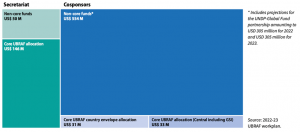
The UBRAF traditionally includes catalytic funds for Cosponsors to both engage them in the joint response and enable them to integrate HIV in corporate strategies, programmes, and budgets. Currently, about 30% of the annual UBRAF budget is allocated to Cosponsors (the grey and green boxes in Figure 3) and 70% is allocated to the Secretariat (global centre and regional and country offices).
Figure 3: Estimated UBRAF core and non-core funds for 2022-23
Cosponsors consider this allocation to be out of balance
Cosponsors note that no other UN joint programme or initiative ever had a Secretariat of this size with posts at such a high level. Importantly, catalytic funding to Cosponsors has decreased further in recent years as a result of the revised ‘operational model’ and funding shortfalls, leading to additional tension. First, since 2018, half of the Cosponsor catalytic funding has been channelled to country-level joint Cosponsor programmes as country envelopes rather than to headquarters. While country-level Cosponsor and Secretariat staff welcomed this move, Cosponsor global HIV co-ordinators saw this as “reducing agency”. Second, as the 2022-23 UBRAF was not fully funded, catalytic funds for Cosponsors – both central and country envelopes – decreased even further. Cosponsors argue that in proportional terms, their allocation was cut more than the Secretariat’s allocation.
Figure 4: Actual UBRAF Funds for UNAIDS Cosponsors and Secretariat
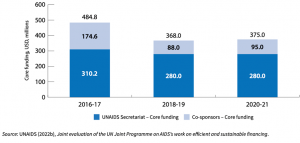
However, the resource allocation for UNAIDS as a whole is biased in favour of the Cosponsors as it includes resources raised by each agency outside the UBRAF. Cosponsors raise funds for their HIV programming in support of the UBRAF workplan but outside the UBRAF core budget. Total projected non-core funding for HIV programming is $1.1 billion for the 2022-23 biennium, raised largely from the same donors that support the UBRAF budget. This is more than ten times the non-core funding that the Secretariat raises, mainly from the US government and earmarked for the Technical Support Mechanism (Figure 3). This relatively high Cosponsor HIV funding includes the United Nations Development Programme (UNDP) Global Fund partnership funds ($610 million) to manage Global Fund programmes at country level. In the context of Cosponsor demands for greater access to UBRAF resources, it is worth noting that in contrast to UN agencies, the Secretariat’s alternatives for receiving funding are very limited. Unlike most Cosponsors, the Secretariat does not receive assessed member state contributions as unearmarked funding.
Looking Forward
According to the 2018 UNAIDS Joint Programme Division of Labour, the Secretariat is expected to fulfil the five sets of functions listed in the background above. Looking forward from March 2021 to 2026 and beyond, MOPAN found that the Secretariat is partly fit for purpose to perform these Secretariat functions of the UNAIDS Joint Programme.
Table 2: Forward-looking assessment of Secretariat functions
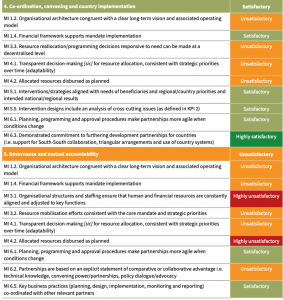
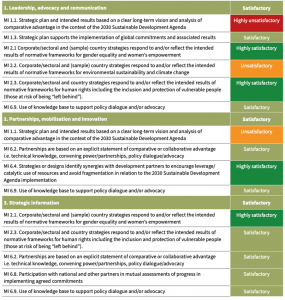
The assessment found the UNAIDS Secretariat to be well equipped to perform its technical functions. The Secretariat’s technical ‘strategic information’ function is strong. It provides global partners with necessary information for planning and supports countries with HIV surveillance. In its ‘country implementation support’ function, the Secretariat successfully supports national governments and civil society partners through JUNTA, technical guidance, dedicated funding envelopes, and the Technical Support Mechanism.
The report lists the Secretariat’s three main strengths to build on:
- The Secretariat leads the GAS development effectively and continues to improve the UBRAF as a results framework for the UN contribution to the global response.
- It is recognised for its ability to lead an HIV-relevant policy dialogue with member states and for advancing global guidance and norms.
- It is a key provider of strategic information. The data on the global AIDS epidemiology and response produced by the Secretariat’s strategic information unit support strategic planning effectively at country level.
However, the assessment concluded that the Secretariat’s strained relations with Cosponsor representatives and the challenges associated with fully resourcing the UBRAF have created a vicious circle that threatens the continued effectiveness of the Secretariat as a co-ordinator of the Joint Programme. The inability of the Secretariat to lead UNAIDS to 2030 and beyond undermines the relevance and effectiveness of the joint and co-sponsored UN response to HIV. Nonetheless, the assessment found consensus among global stakeholders on the continued need for a co-ordinated UN response – and thus for a Secretariat function – now and in the future.
Areas for attention for the UNAIDS Secretariat
The report lists four of these:
- The Secretariat is not able to address the expectations of the Cosponsors, resulting in a loss of confidence of key Cosponsor representatives and affecting its co-ordination function.
- The Secretariat resource mobilization strategy for the UBRAF has not kept up with the realities of global HIV funding (trending towards less HIV investment and more earmarked funding for specific activities), as it aims to sustain current budget and funding levels.
- The Secretariat leadership pursues an advocacy agenda that deviates from the HIV pandemic, UNAIDS’ core mandate. This has resulted in criticism of its core function of global leadership and also in accusations of mission creep.
- The Secretariat needs to put appropriate resources, structures and monitoring in place to implement the 2023 WHO policy on sexual misconduct. Ensuring it does so in a victim/survivor-centred way will be essential for building trust as it emerges from a high-profile case of sexual harassment and abuse of power.
Many global partners are looking for leadership from the UNAIDS Secretariat to create a long-term vision for the post-2030 UN response. With time, there will be even fewer resources for HIV and less unearmarked funding, underscoring the need for a rethink of relations between the Secretariat and Cosponsors.
The report states that many stakeholders echo the recommendations of earlier reviews for a reset of UNAIDS and the Secretariat. This is based on a critical assessment of HIV epidemic scenarios and needs beyond 2030, on an assessment of the UN system response to AIDS beyond 2030, and on a review of the necessary operational model. The reset should include:
- A review of the continued relevance and cost-effectiveness of the current constellation of Cosponsors, including redefining ‘co-sponsorship’ to ‘paying for Secretariat functions’ and making co-sponsorship and/or membership flexible.
- A review of the role and size of the Secretariat, including identifying lessons from other UN joint programmes (e.g. the Human Reproduction Programme) and separating the Secretariat’s technical functions (country support, global HIV monitoring) from the co-ordination functions or finding another home for them.
- A redefinition of the ‘investment case’ for UBRAF donors as the 2022-26 resource mobilisation strategy calls for recognition of the need to reduce the budget and earmark funding to concrete UBRAF outputs.
As the report states: the UNAIDS governance mechanism, the PCB, may need to step in and go back to the drawing board to review and decide on the long-term options for a UN joint response. Frank and constructive discussion is needed at the UNAIDS governance level, engaging heads of Cosponsor agencies, donors and member states.
Tags:
Leave a Comment
Comments
No comments yet. Be the first to comment!