The Global Fund’s 2023 Results Report
Losses due to COVID-19 have been more than reversed but “the world at large will not achieve the 2030 target unless global action results in making extraordinary strides” says the Report
Article Type:
News
Author:
Date:
2023-10-10
ABSTRACT
The Global Fund Results Report 2023 describes how its investments continued to deliver lifesaving services for people affected by HIV, TB and malaria. The Global Fund partnership also played an important role in supporting countries and communities to accelerate their recovery from the COVID-19 pandemic and build resilient and sustainable systems for health able to respond to current and future health threats. Our article brings you the salient highlights of the new report just published.
2022, says the Global Fund, was a year of rapid acceleration in the Global Fund partnership’s fight against HIV, TB and malaria (HTM). Programs to tackle the three diseases showed a robust recovery following COVID-19 disruptions. After seeing the gains of the last two decades sharply reversed during 2020 and only a partial recovery the following year, in 2022 the organization put more people on HIV antiretroviral therapy (ART) than ever before; it found and put more people with TB on treatment than previously, and it distributed a record number of mosquito nets to prevent malaria. Overall, most of the Fund’s prevention and treatment programs exceeded pre-COVID-19 pandemic results.
This article brings you the most striking findings of the report which you can download here.
59 million lives saved
Since its creation, health programs supported by the Global Fund partnership have saved 59 million lives.
 Since 2002, the Global Fund partnership has cut the combined death rate from AIDS, TB and malaria (ATM) by 55%. Thanks to the efforts of communities, governments, the private sector, civil society, and its technical partners, HTM programs have registered strong recoveries from the impact of COVID-19, delivering some record-breaking results.
However, multiple challenges, including climate change and conflict, as well as deepening inequalities and a growing threat to human rights, have put the target to end the ATM epidemics by 2030 increasingly at risk. To halt these diseases, the Global Fund says, we must continue to invest in innovations while accelerating efforts to end the stark inequities that fuel HTM.
Since 2002, the Global Fund partnership has cut the combined death rate from AIDS, TB and malaria (ATM) by 55%. Thanks to the efforts of communities, governments, the private sector, civil society, and its technical partners, HTM programs have registered strong recoveries from the impact of COVID-19, delivering some record-breaking results.
However, multiple challenges, including climate change and conflict, as well as deepening inequalities and a growing threat to human rights, have put the target to end the ATM epidemics by 2030 increasingly at risk. To halt these diseases, the Global Fund says, we must continue to invest in innovations while accelerating efforts to end the stark inequities that fuel HTM.
 Prevention and treatment interventions for HIV, TB and malaria
The coverage of HTM prevention and treatment interventions in countries where the Global Fund invests has increased rapidly since its establishment in 2002. In 2022, HIV prevention services increased by 22% compared to 2021. The number of people diagnosed and treated for TB increased by 26%, and the number of cases of malaria treated increased by 11%. The Global Fund is investing to get the world back on track toward ending HTM and making the world more equitable and safer from future threats.
It measures its progress against the targets in the global HTM plans and in the Sustainable Development Goal (SDG) 3 of health and well-being for all. Its achievements are the result of efforts by a wide array of actors comprising the Global Fund partnership, including governments, multilateral agencies, bilateral partners, the private sector, civil society groups, and people affected by the three diseases.
Prevention and treatment interventions for HIV, TB and malaria
The coverage of HTM prevention and treatment interventions in countries where the Global Fund invests has increased rapidly since its establishment in 2002. In 2022, HIV prevention services increased by 22% compared to 2021. The number of people diagnosed and treated for TB increased by 26%, and the number of cases of malaria treated increased by 11%. The Global Fund is investing to get the world back on track toward ending HTM and making the world more equitable and safer from future threats.
It measures its progress against the targets in the global HTM plans and in the Sustainable Development Goal (SDG) 3 of health and well-being for all. Its achievements are the result of efforts by a wide array of actors comprising the Global Fund partnership, including governments, multilateral agencies, bilateral partners, the private sector, civil society groups, and people affected by the three diseases.
 In 2022, the Global Fund supported countries to recover from the impact of COVID-19 and continue to expand their HIV programs. Despite this progress, 39 million people were living with HIV, 1.3 million people were newly infected with the virus, and 630,000 people died of AIDS-related causes in 2022. The Report asserts that we need to take bold action to get back on track and achieve the SDG target of ending AIDS as a public health threat by 2030.
TB
In 2022, TB programs achieved a sharp acceleration and remarkable recovery following severe disruptions caused by the COVID-19 pandemic in 2020 and 2021.
In the countries where the Global Fund invests, the number of people with TB who were diagnosed and treated in 2022 surpassed the numbers reported in 2019 – the most recent high before COVID-19 negatively impacted TB programs. In 2022, there was a sharp increase in TB screening and testing in the countries where the Global Fund invests. 6.7 million people with TB were diagnosed and treated in 2022, surpassing the number reported in 2019 (5.8 million).
In 2022, the Global Fund supported countries to recover from the impact of COVID-19 and continue to expand their HIV programs. Despite this progress, 39 million people were living with HIV, 1.3 million people were newly infected with the virus, and 630,000 people died of AIDS-related causes in 2022. The Report asserts that we need to take bold action to get back on track and achieve the SDG target of ending AIDS as a public health threat by 2030.
TB
In 2022, TB programs achieved a sharp acceleration and remarkable recovery following severe disruptions caused by the COVID-19 pandemic in 2020 and 2021.
In the countries where the Global Fund invests, the number of people with TB who were diagnosed and treated in 2022 surpassed the numbers reported in 2019 – the most recent high before COVID-19 negatively impacted TB programs. In 2022, there was a sharp increase in TB screening and testing in the countries where the Global Fund invests. 6.7 million people with TB were diagnosed and treated in 2022, surpassing the number reported in 2019 (5.8 million).
 The Results report notes that malaria has shown that we must stay ahead of it to eliminate it. Together with the U.S. President’s Malaria Initiative and other partners, in 2022 the Global Fund invested in tools, partnerships and innovations to combat insecticide and drug resistance and make its interventions more cost-effective. The Global Fund says that harnessing innovation, strengthening disease surveillance systems and testing new products proven to be safe and effective – such as next-generation nets, insecticides, treatments or vaccines – are essential in this ongoing fight against the disease.
Strengthening systems for health
Resilient and sustainable systems for health (RSSH), says the Report, underpin the fight against diseases and are the foundation for preventing, detecting and responding to existing and emerging health threats. The Global Fund is the world’s largest multilateral provider of grants for strengthening systems for health, investing $1.5 billion a year in formal and community health systems between 2021 and 2023 through its core grants and its COVID-19 Response Mechanism (C19RM). In total, the Global Fund raised close to $5 billion to support countries in responding to COVID-19; approximately $2.2 billion of this financing will be used to strengthen systems for health and enhance pandemic preparedness. By investing in key components of resilient health systems, the Global Fund says, it “supports countries to fight the disease threats of today while preparing for those of tomorrow”.
The Results report notes that malaria has shown that we must stay ahead of it to eliminate it. Together with the U.S. President’s Malaria Initiative and other partners, in 2022 the Global Fund invested in tools, partnerships and innovations to combat insecticide and drug resistance and make its interventions more cost-effective. The Global Fund says that harnessing innovation, strengthening disease surveillance systems and testing new products proven to be safe and effective – such as next-generation nets, insecticides, treatments or vaccines – are essential in this ongoing fight against the disease.
Strengthening systems for health
Resilient and sustainable systems for health (RSSH), says the Report, underpin the fight against diseases and are the foundation for preventing, detecting and responding to existing and emerging health threats. The Global Fund is the world’s largest multilateral provider of grants for strengthening systems for health, investing $1.5 billion a year in formal and community health systems between 2021 and 2023 through its core grants and its COVID-19 Response Mechanism (C19RM). In total, the Global Fund raised close to $5 billion to support countries in responding to COVID-19; approximately $2.2 billion of this financing will be used to strengthen systems for health and enhance pandemic preparedness. By investing in key components of resilient health systems, the Global Fund says, it “supports countries to fight the disease threats of today while preparing for those of tomorrow”.
 C19RM funds are being reinvested into key RSSH components, including laboratory systems, to support countries to confront existing and future global health threats. The increase shown in Figure 8 only includes investments that specifically focus on laboratory systems strengthening and excludes other laboratory-related investments.
Colliding multiple crises
Echoing Peter Sands’ speech to the 2022 November Board meeting, the Results Report talks about the multiple crises beyond COVID-19, including climate change, conflict, debt, an alarming erosion of human rights, as well as deepening inequities within and between countries. These, it states, make our efforts to end ATM more challenging. These crises also put the poorest and most marginalized more at risk from the deadliest infectious diseases.
Extreme weather events are causing dramatic upsurges in malaria infections. Food insecurity and displacement increase the risk of acquiring HIV and TB and undermine people’s access to treatment. Meanwhile, economic and debt crises have shrunk countries’ health budgets, while attacks on human rights prevent KP most at risk from accessing lifesaving health services.
The Global Fund is uniquely positioned to respond to these crises. In addition to strengthening countries’ systems for health, it provides emergency funds and partners with humanitarian organizations to support populations made vulnerable by conflict and climate disasters. It also provides support to tackle human rights- and gender-related barriers to health services. But, it says, it must redouble its efforts to end ATM and build a healthier and more equitable world.
C19RM funds are being reinvested into key RSSH components, including laboratory systems, to support countries to confront existing and future global health threats. The increase shown in Figure 8 only includes investments that specifically focus on laboratory systems strengthening and excludes other laboratory-related investments.
Colliding multiple crises
Echoing Peter Sands’ speech to the 2022 November Board meeting, the Results Report talks about the multiple crises beyond COVID-19, including climate change, conflict, debt, an alarming erosion of human rights, as well as deepening inequities within and between countries. These, it states, make our efforts to end ATM more challenging. These crises also put the poorest and most marginalized more at risk from the deadliest infectious diseases.
Extreme weather events are causing dramatic upsurges in malaria infections. Food insecurity and displacement increase the risk of acquiring HIV and TB and undermine people’s access to treatment. Meanwhile, economic and debt crises have shrunk countries’ health budgets, while attacks on human rights prevent KP most at risk from accessing lifesaving health services.
The Global Fund is uniquely positioned to respond to these crises. In addition to strengthening countries’ systems for health, it provides emergency funds and partners with humanitarian organizations to support populations made vulnerable by conflict and climate disasters. It also provides support to tackle human rights- and gender-related barriers to health services. But, it says, it must redouble its efforts to end ATM and build a healthier and more equitable world.
 To end HTM as public health threats and address emerging dangers to global health security, we need to reach the most vulnerable people with prevention and treatment services, wherever they are.
Investing for Impact
Since 2002, the Global Fund has provided $15 billion to support crucial HTM prevention and treatment services and strengthen health systems in challenging operating environments, or countries or regions that experience infectious disease outbreaks, natural disasters, armed conflicts or civil unrest, weak governance, climate change-related crises and/or mass displacement.
The Report talks about how Global Fund galvanizes the world to invest in the fight against the deadliest infectious diseases while challenging the injustice that continues to fuel them. Since its founding in 2002, the Global Fund has disbursed more than $60.4 billion to respond to HTM and COVID-19 and RSSH across more than 120 countries as of June 2023. In 2022, the Global Fund disbursed a record $5.2 billion to fight HTM, support C19RM activities, and strengthen the systems for health that underpin any pandemic response. These investments helped save many lives from HTM and COVID-19 and accelerated the recovery from the impact of COVID-19 on the programs supported by the Global Fund.
The Global Fund Results Methodology
The Global Fund Results Report 2023 presents selected programmatic results (e.g., people on ART, people treated for TB, mosquito nets distributed) achieved by supported programs in 2022. The programmatic results are reported routinely to the Global Fund by these programs. The data collected by the Fund’s technical partners are also used for cross-checking and triangulation and for furnishing national data for selected services to align with the Global Fund partnership’s approach in results reporting. The Global Fund also uses official disease burden and impact estimates developed and published by its technical partners, including UNAIDS and WHO, as the basis for measuring impact.
To end HTM as public health threats and address emerging dangers to global health security, we need to reach the most vulnerable people with prevention and treatment services, wherever they are.
Investing for Impact
Since 2002, the Global Fund has provided $15 billion to support crucial HTM prevention and treatment services and strengthen health systems in challenging operating environments, or countries or regions that experience infectious disease outbreaks, natural disasters, armed conflicts or civil unrest, weak governance, climate change-related crises and/or mass displacement.
The Report talks about how Global Fund galvanizes the world to invest in the fight against the deadliest infectious diseases while challenging the injustice that continues to fuel them. Since its founding in 2002, the Global Fund has disbursed more than $60.4 billion to respond to HTM and COVID-19 and RSSH across more than 120 countries as of June 2023. In 2022, the Global Fund disbursed a record $5.2 billion to fight HTM, support C19RM activities, and strengthen the systems for health that underpin any pandemic response. These investments helped save many lives from HTM and COVID-19 and accelerated the recovery from the impact of COVID-19 on the programs supported by the Global Fund.
The Global Fund Results Methodology
The Global Fund Results Report 2023 presents selected programmatic results (e.g., people on ART, people treated for TB, mosquito nets distributed) achieved by supported programs in 2022. The programmatic results are reported routinely to the Global Fund by these programs. The data collected by the Fund’s technical partners are also used for cross-checking and triangulation and for furnishing national data for selected services to align with the Global Fund partnership’s approach in results reporting. The Global Fund also uses official disease burden and impact estimates developed and published by its technical partners, including UNAIDS and WHO, as the basis for measuring impact.
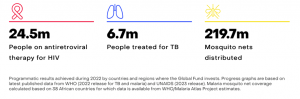
Figure 1. HIV, TB and malaria status at a glance
Since 2002, the Global Fund partnership has cut the combined death rate from AIDS, TB and malaria (ATM) by 55%. Thanks to the efforts of communities, governments, the private sector, civil society, and its technical partners, HTM programs have registered strong recoveries from the impact of COVID-19, delivering some record-breaking results.
However, multiple challenges, including climate change and conflict, as well as deepening inequalities and a growing threat to human rights, have put the target to end the ATM epidemics by 2030 increasingly at risk. To halt these diseases, the Global Fund says, we must continue to invest in innovations while accelerating efforts to end the stark inequities that fuel HTM.
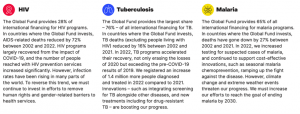
Figure 2. State of the fight
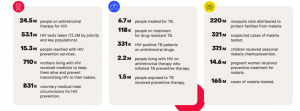
Figure 3. Key results in 2022
Prevention and treatment interventions for HIV, TB and malaria
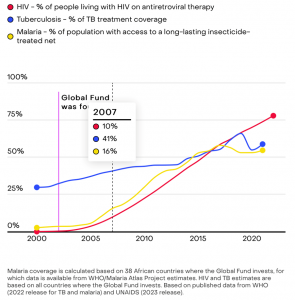
The coverage of HTM prevention and treatment interventions in countries where the Global Fund invests has increased rapidly since its establishment in 2002. In 2022, HIV prevention services increased by 22% compared to 2021. The number of people diagnosed and treated for TB increased by 26%, and the number of cases of malaria treated increased by 11%. The Global Fund is investing to get the world back on track toward ending HTM and making the world more equitable and safer from future threats.
It measures its progress against the targets in the global HTM plans and in the Sustainable Development Goal (SDG) 3 of health and well-being for all. Its achievements are the result of efforts by a wide array of actors comprising the Global Fund partnership, including governments, multilateral agencies, bilateral partners, the private sector, civil society groups, and people affected by the three diseases.
Figure 4. Coverage of prevention and treatment interventions
Source: Global Fund Data Explorer
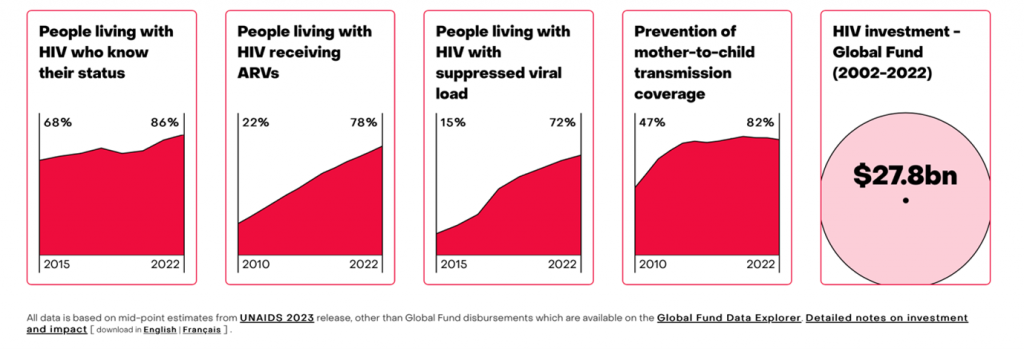
HIV In 2022, there was an accelerated recovery of HIV testing services for groups in greatest need. 15.3 million people were reached with HIV prevention services, including 6.8 million key population (KP) members and 7.6 million young people (including 3.6 million adolescent girls and young women). The Global Fund supports the procurement of innovative tools such as long-acting pre-exposure prophylaxis (PrEP) including injectable cabotegravir (CAB-LA) as well the Dapivirine vaginal ring. It also invests in fostering community engagement and leadership to reach key and vulnerable populations at a much higher risk of acquiring HIV than the general population. 24.5 million people were on lifesaving ART in countries where the Global Fund invests in 2022, up from 17.5 million in 2017. The percentage of people in need of ART who received it has significantly increased in recent years, from 48% in 2015 to 78% in 2022. The Fund is also investing in innovative efforts to address the burden of pediatric HIV by supporting countries to adopt a dolutegravir-based treatment formulation for children. Together with the U.S. President’s Emergency Plan for AIDS Relief (PEPFAR) and other partners, its efforts to implement the World Health Organization’s (WHO) “treat all” guidance and the UNAIDS “95-95-95” strategy have significantly increased the number of people diagnosed with HIV and started on ART.Figure 5. HIV results at a glance
In 2022, the Global Fund supported countries to recover from the impact of COVID-19 and continue to expand their HIV programs. Despite this progress, 39 million people were living with HIV, 1.3 million people were newly infected with the virus, and 630,000 people died of AIDS-related causes in 2022. The Report asserts that we need to take bold action to get back on track and achieve the SDG target of ending AIDS as a public health threat by 2030.
TB
In 2022, TB programs achieved a sharp acceleration and remarkable recovery following severe disruptions caused by the COVID-19 pandemic in 2020 and 2021.
In the countries where the Global Fund invests, the number of people with TB who were diagnosed and treated in 2022 surpassed the numbers reported in 2019 – the most recent high before COVID-19 negatively impacted TB programs. In 2022, there was a sharp increase in TB screening and testing in the countries where the Global Fund invests. 6.7 million people with TB were diagnosed and treated in 2022, surpassing the number reported in 2019 (5.8 million).
Figure 5. TB results at a glance
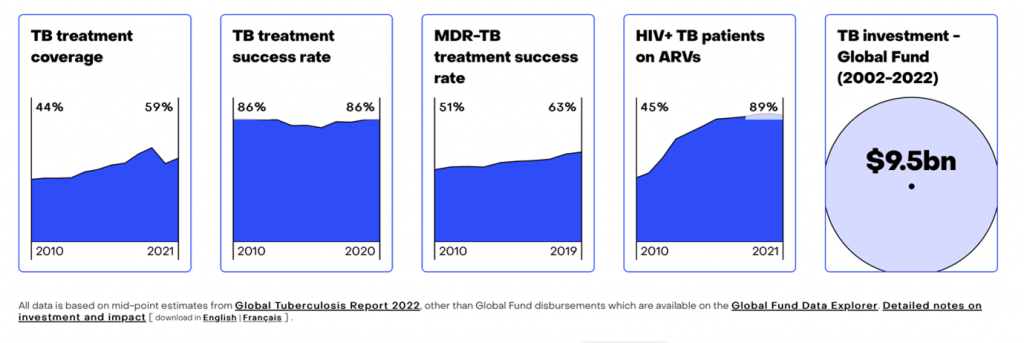
Figure 7. Malaria results at a glance
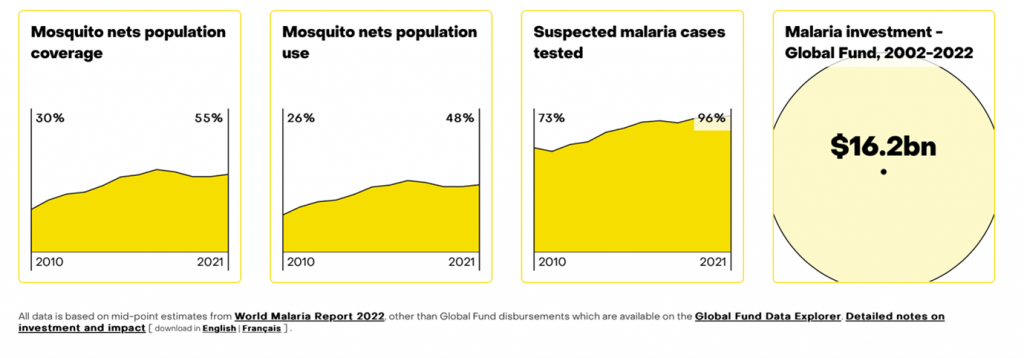
The Results report notes that malaria has shown that we must stay ahead of it to eliminate it. Together with the U.S. President’s Malaria Initiative and other partners, in 2022 the Global Fund invested in tools, partnerships and innovations to combat insecticide and drug resistance and make its interventions more cost-effective. The Global Fund says that harnessing innovation, strengthening disease surveillance systems and testing new products proven to be safe and effective – such as next-generation nets, insecticides, treatments or vaccines – are essential in this ongoing fight against the disease.
Strengthening systems for health
Resilient and sustainable systems for health (RSSH), says the Report, underpin the fight against diseases and are the foundation for preventing, detecting and responding to existing and emerging health threats. The Global Fund is the world’s largest multilateral provider of grants for strengthening systems for health, investing $1.5 billion a year in formal and community health systems between 2021 and 2023 through its core grants and its COVID-19 Response Mechanism (C19RM). In total, the Global Fund raised close to $5 billion to support countries in responding to COVID-19; approximately $2.2 billion of this financing will be used to strengthen systems for health and enhance pandemic preparedness. By investing in key components of resilient health systems, the Global Fund says, it “supports countries to fight the disease threats of today while preparing for those of tomorrow”.
Figure 8. Investments in laboratory systems
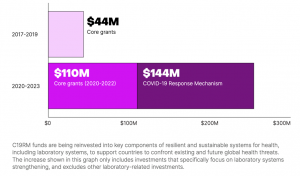
C19RM funds are being reinvested into key RSSH components, including laboratory systems, to support countries to confront existing and future global health threats. The increase shown in Figure 8 only includes investments that specifically focus on laboratory systems strengthening and excludes other laboratory-related investments.
Colliding multiple crises
Echoing Peter Sands’ speech to the 2022 November Board meeting, the Results Report talks about the multiple crises beyond COVID-19, including climate change, conflict, debt, an alarming erosion of human rights, as well as deepening inequities within and between countries. These, it states, make our efforts to end ATM more challenging. These crises also put the poorest and most marginalized more at risk from the deadliest infectious diseases.
Extreme weather events are causing dramatic upsurges in malaria infections. Food insecurity and displacement increase the risk of acquiring HIV and TB and undermine people’s access to treatment. Meanwhile, economic and debt crises have shrunk countries’ health budgets, while attacks on human rights prevent KP most at risk from accessing lifesaving health services.
The Global Fund is uniquely positioned to respond to these crises. In addition to strengthening countries’ systems for health, it provides emergency funds and partners with humanitarian organizations to support populations made vulnerable by conflict and climate disasters. It also provides support to tackle human rights- and gender-related barriers to health services. But, it says, it must redouble its efforts to end ATM and build a healthier and more equitable world.
Progress towards the global targets
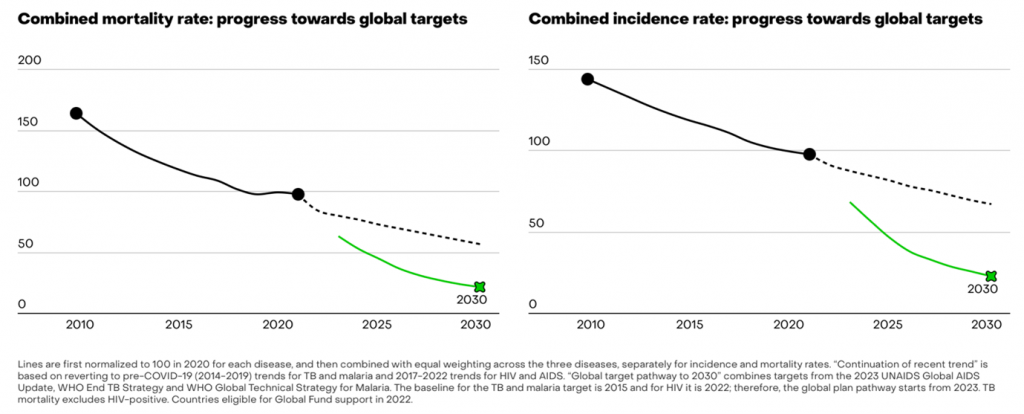
Despite its remarkable turnaround in programmatic results since the COVID-19 pandemic, the Global Fund notes that it remains off the trajectory required to achieve the SDG 3 target of ending HTM by 2030. Across all three diseases, and especially TB and malaria, the Global Fund and indeed the world at large will not achieve the 2030 target unless global action results in making extraordinary strides. The report says, “we must invest more, become smarter in how we invest, not least by accelerating the deployment of innovations to those who need them most, and we must redouble our efforts to end the stark inequities that fuel these diseases”.Figure 9. Progress towards global targets: mortality rate and incidence
To end HTM as public health threats and address emerging dangers to global health security, we need to reach the most vulnerable people with prevention and treatment services, wherever they are.
Investing for Impact
Since 2002, the Global Fund has provided $15 billion to support crucial HTM prevention and treatment services and strengthen health systems in challenging operating environments, or countries or regions that experience infectious disease outbreaks, natural disasters, armed conflicts or civil unrest, weak governance, climate change-related crises and/or mass displacement.
The Report talks about how Global Fund galvanizes the world to invest in the fight against the deadliest infectious diseases while challenging the injustice that continues to fuel them. Since its founding in 2002, the Global Fund has disbursed more than $60.4 billion to respond to HTM and COVID-19 and RSSH across more than 120 countries as of June 2023. In 2022, the Global Fund disbursed a record $5.2 billion to fight HTM, support C19RM activities, and strengthen the systems for health that underpin any pandemic response. These investments helped save many lives from HTM and COVID-19 and accelerated the recovery from the impact of COVID-19 on the programs supported by the Global Fund.
The Global Fund Results Methodology
The Global Fund Results Report 2023 presents selected programmatic results (e.g., people on ART, people treated for TB, mosquito nets distributed) achieved by supported programs in 2022. The programmatic results are reported routinely to the Global Fund by these programs. The data collected by the Fund’s technical partners are also used for cross-checking and triangulation and for furnishing national data for selected services to align with the Global Fund partnership’s approach in results reporting. The Global Fund also uses official disease burden and impact estimates developed and published by its technical partners, including UNAIDS and WHO, as the basis for measuring impact.
Publication Date:
2023-10-10
Tags:
Leave a Comment
Comments
No comments yet. Be the first to comment!